// TOM'S HARDWARE US — HARDWARE & GADGET
AI agents design an entirely new CPU architecture from scratch, startup claims
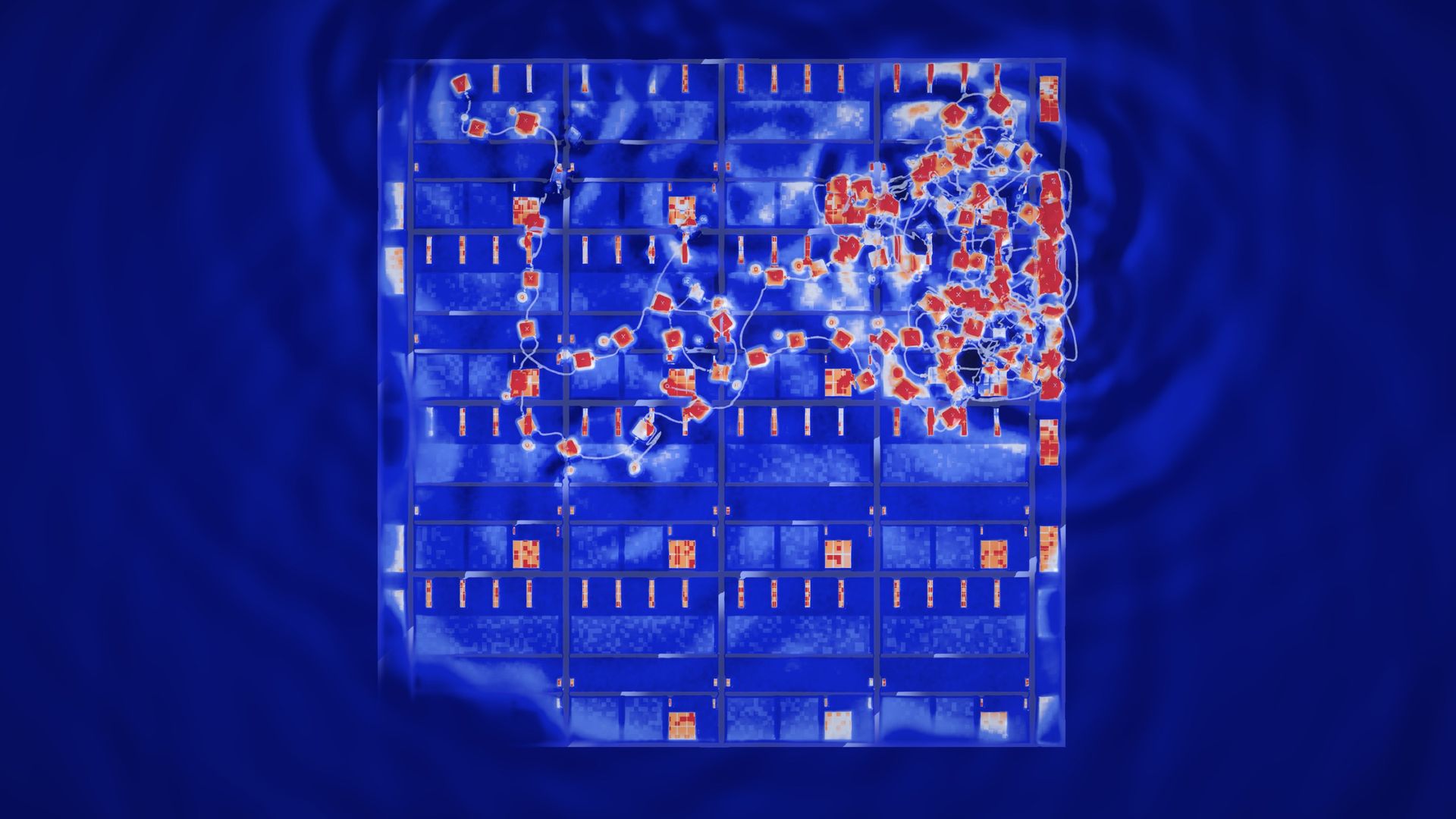
Its lead shrinks to 3.83x on the 15 workloads without AI tuning.
When you purchase through links on our site, we may earn an affiliate commission. Here’s how it works.
Architect Labs, a Palo Alto startup, said in a research blog post that its AI systems discovered, designed, and verified Frostbite, a general-purpose CPU with a new instruction set “built from the ground up.” Across 25 workloads, a four-tile Frostbite cluster delivered 4.59 times the performance per watt of a similarly sized “silicon-proven” dual-issue, in-order CPU core. Those numbers come from a simulated 7nm design that has not yet been made in silicon, and the company says it can’t name the comparison core for legal reasons.
Conventional CPUs have hardware that “rediscovers, at runtime, which instructions actually depend on each other.” Multicore designs also need deep cache hierarchies and coherence protocols, which keep every core’s view of shared memory consistent, but scale poorly and cost area and power. Architect Labs’ alternative is what it calls “multithreading for free,” where the program itself exposes the parallel work, without threads, locks, or out-of-order hardware required for that discovery.
Frostbite’s programs are compiled to interaction nets, a model of computation from 1990 in which a program is a graph of nodes and computation happens by rewriting pairs of connected nodes, and the chip is designed around this distinct paradigm. Pairs of nodes being rewritten never overlap, so they can run in any order, or all at once, and arrive at the same result. Every value is also used exactly once, so data can stay in small local memories instead of large shared caches.
An example of the difference given by the team is a 5x5 chess-like board with five queens, placed so none can attack another. A typical program searches for solutions one board at a time. As an interaction net, the same search breaks into 3,183 small operations, and the longest chain that has to run in order is only 262 steps, so on average about 12 operations are ready to run at once at each step. Nothing about the program was rewritten to get there, as the parallel work was already intrinsic.
Each of the chip’s tiles, small identical processing units linked by an on-chip network, has its own small local memory. Four tiles, plus four L3 nodes, form the cluster that’s benchmarked against the conventional core for the performance claims, but the full layout has 16 tiles. The design reached 800 MHz in early synthesis but ended up at 500 MHz in the final layout. The cluster also averaged 8.77 times the comparison core’s performance per area, and the table below shows how its performance per watt varies by workload.
It may come as some surprise that the AI which built Frostbite started with what the company calls “zero architectural priors,” though the team first picked the workloads it had to do well on, and this sort of blank slatism may have its advantages in avoiding bias. Instead, the agents read papers and benchmarks, built Python models, and then selected one concept for focus. The original 141-page PDF output, which contained a programming model, runtime, and high-level blocks, was deleted after the first register-transfer level (RTL) design was generated, because “many of the numbers and estimates were well off what was physically possible.”
That PDF was only ever a starting point. Once the agents picked an architecture, they moved away from English — as it can’t get every detail right or catch every mistake, according to the team — and wrote the spec in the company’s own language, called ASL. ASL translates to Lean, a proof checker, so it can be machine-checked, which the company says stops a large class of bugs and cuts down on agents gaming their objectives. From this, the agents devised Arcmodel, a software model of the whole chip written in ASL, before any circuit design existed.
Get Tom's Hardware's best news and in-depth reviews, straight to your inbox.