// SPACE.COM — SPAZIO & SCIENZA
What did the Soviet Union's final deep space probe actually see on Mars?
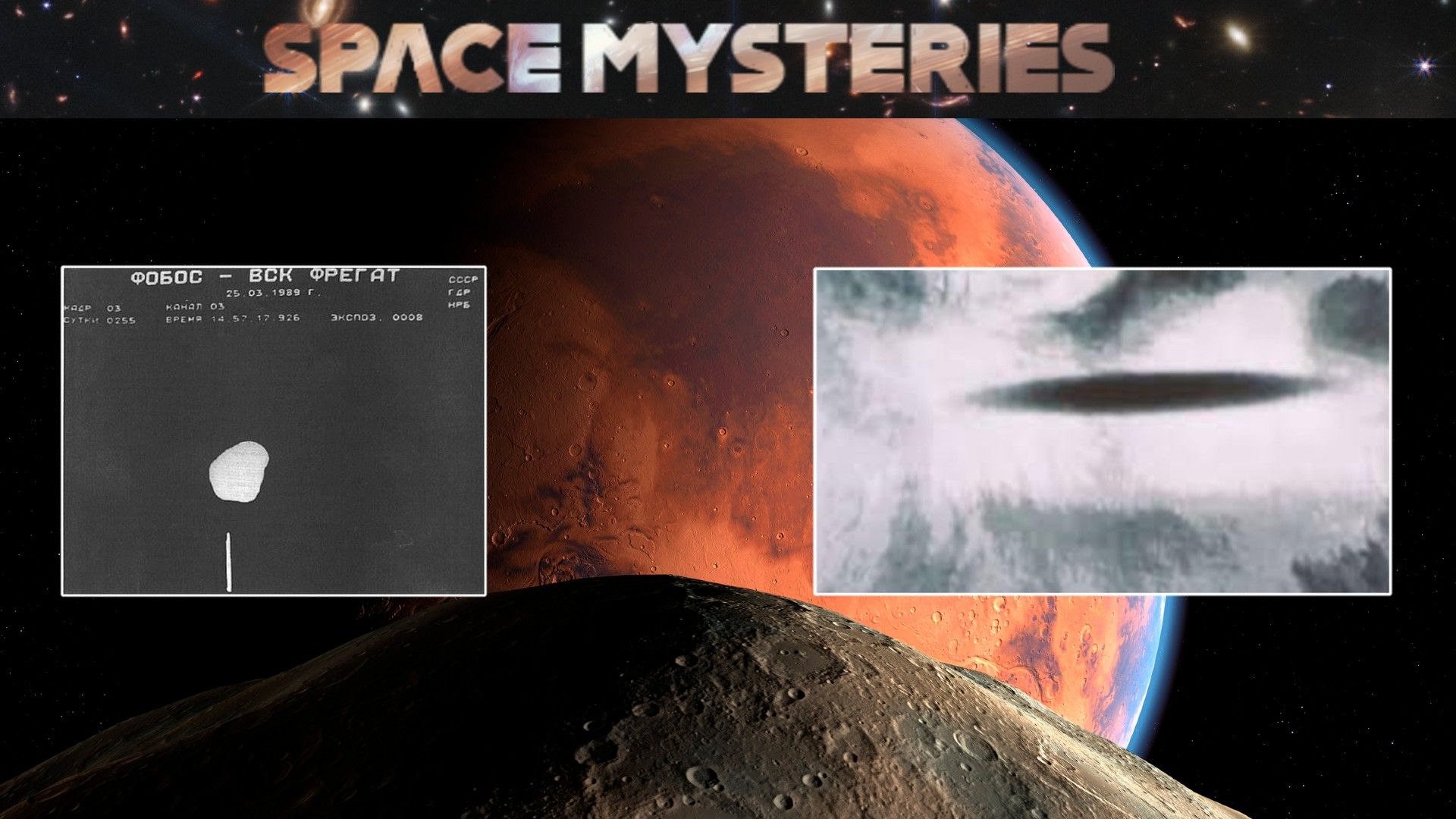
Conspiracy theories surround the appearance of objects seen in the final images captured by Phobos 2, the Soviet Union's last mission into deep space.
When you purchase through links on our site, we may earn an affiliate commission. Here’s how it works.
On July 12, 1988, Phobos 2 — one of the Soviet Union's final major planetary exploration probes — was launched from Baikonur Cosmodrome aboard a Proton rocket. The spacecraft's mission included the study of Mars and the Martian moon Phobos, with a planned close approach and deployment of landing probes, and over the next several months, the spacecraft successfully captured more than three dozen images of Phobos during its time in service.
However, early in the following year, the spacecraft's mission abruptly ended after the Phobos 2 ground team mysteriously lost contact with the spacecraft. Adding to the mystery were objects in some of the final photographs dispatched by the doomed spacecraft, which seemed to show an elongated shadow beneath the probe — a strange twist in one of the Soviet Union's final space missions, and one that soon gave rise to conspiracy theories about what the fate of Phobos 2 might have been.
So what caused the odd-looking appearance of the shadow in the final images captured by Phobos 2, and what was the real reason behind the spacecraft's sudden failure?
Originally, the Soviet Union had planned for Phobos 2 to reach the Red Planet by late January 1989, after which the spacecraft would begin collecting data about the Martian environment leading up to its initial contact with Mars' largest moon in early June.
To say that a lot hinged on the success of the mission would be an understatement, given the unfortunate fate of the probe's predecessor, Phobos 1, which went offline on Sept. 2, 1988, after a faulty command sequence was initiated while the spacecraft was on its way to Mars. The stakes were almost immediately raised as Phobos 2 arrived in orbit around Mars on Jan. 30, 1989, when one of the probe's three onboard flight system processors was found to have gone offline, with another already experiencing technical issues.
Over the course of the next several weeks, Phobos 2 was able to overcome some of these setbacks and successfully began sending useful scientific data about the Martian environment back to Earth. By March, all the probe's science instruments appeared to be functioning normally, and despite the earlier loss of one of its processors, the remaining two had continued to facilitate control of the spacecraft by its Soviet ground control team.
That all changed on March 27, 1989, as Phobos 2 prepared to capture navigational images of its namesake as the Martian moon passed, which would be useful in advance of another forthcoming flyby in early April.
Achieving this meant that the probe had to be angled in such a way that it faced Phobos, whereby its communications antennas would be temporarily directed away from Earth. During the imaging portion of the maneuver, all appeared to go smoothly, but soon afterward, ground controllers realized they were unable to reestablish contact with the probe.