// NATURE NEWS — SPAZIO & SCIENZA
An enduring climatic burden from past peatland drainage
Nature
(2026) Cite this article
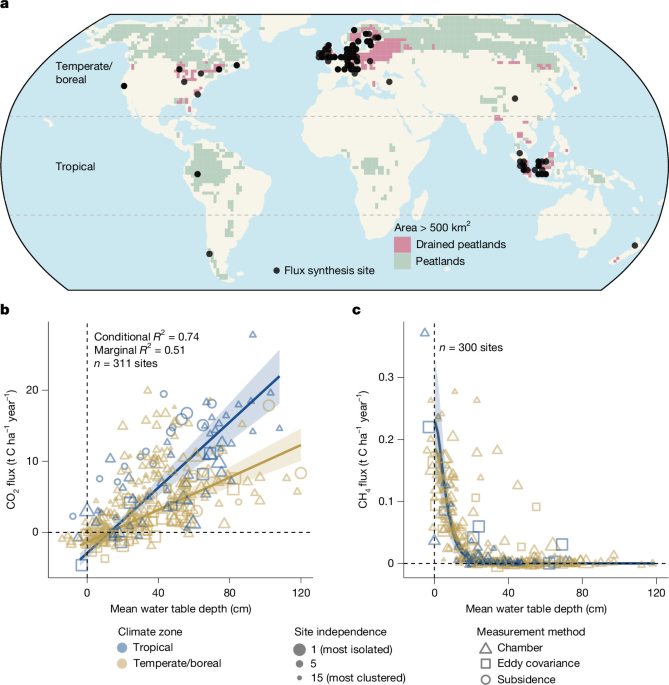
Over millennia, peatlands have removed hundreds of gigatonnes of carbon dioxide (CO2) from the atmosphere but emitted a proportion back as methane (CH4), exerting a slow net cooling effect1. Artificial drainage of these ecosystems—a centuries-old practice2,3—causes decomposition and the re-release of CO2 but suppresses CH4 emissions4, with a net climatic effect that is not well quantified at the global scale5. Here we reconstructed the radiative forcing from worldwide peatland drainage over 1800–2020 by combining a new flux dataset, hydrologically driven models of CO2 and CH4 fluxes and a hindcast of drainage extent and intensity. We found that drainage has produced a net heating effect of +73 (48–99) mW m−2—equivalent to 2.7 (1.8–3.6)% of industrial-era radiative forcing—originating from 0.4–0.5% of global land area. The net heating results from the dominant forcing of drainage-induced CO2 emissions (+83 (52–110) mW m−2) over that of avoided CH4 emissions (−9 (−15–−2) mW m−2). Even without further expansion of drainage, maintaining currently drained areas could almost double the cumulative warming by 2100. Our reconstruction captures the opposing impacts of peatland drainage on global budgets of CO2 and CH4 and quantifies the strong legacy effects of historical drainage on present and possibly future climate.
This is a preview of subscription content, access via your institution
Access Nature and 54 other Nature Portfolio journals
Get Nature+, our best-value online-access subscription
Prices may be subject to local taxes which are calculated during checkout
The raw data and the processed outputs are available from Zenodo (https://zenodo.org/records/23220779)159. Source data are provided with this paper.
The R code to process and analyse the data is available from Zenodo (https://zenodo.org/records/23176614)160.
Frolking, S. & Roulet, N. T. Holocene radiative forcing impact of northern peatland carbon accumulation and methane emissions. Glob. Change Biol. 13, 1079–1088 (2007).
Fluet-Chouinard, E. et al. Extensive global wetland loss over the past three centuries. Nature 614, 281–286 (2023).