// NATURE NEWS — SPAZIO & SCIENZA
Context-dependent response of endothelial cells to PIK3CA mutation
Nature
(2026) Cite this article
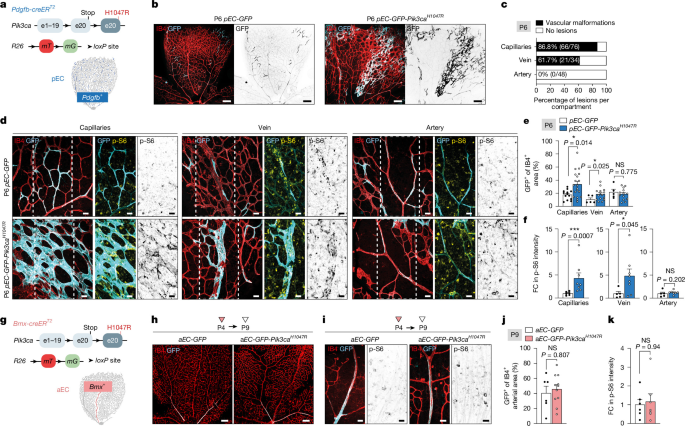
Cancer-associated mutations in PIK3CA underlie congenital overgrowth disorders that frequently involve the vasculature1,2. Among the affected tissues, the endothelium commonly exhibits aberrant expansion, leading to vascular malformations3. Notably, these lesions arise predominantly in veins and capillaries, whereas arteries are largely spared, for reasons that remain unclear. Here, using genetic lineage tracing, we show that endothelial expression of PIK3CAH1047R drives profound clonal expansion of capillary and venous endothelial cells, whereas mature arterial endothelial cells are refractory to pathological PI3K activation. Expression of PIK3CAH1047R in arterial precursors disrupts arterial differentiation and promotes the acquisition of venous features, providing a mechanistic explanation for the paucity of arterial lesions after PIK3CA genetic perturbation. Mechanistically, these effects are mediated by two complementary downstream branches of PI3K signalling: increased proliferation, which drives vascular overgrowth, and upregulation of the venous-specifying transcription factor NR2F2 (also known as COUP-TFII), which suppresses arterial differentiation. Together, our findings reveal that pathogenic responses to PIK3CAH1047R are dictated by endothelial differentiation state and fate trajectory, and demonstrate that arterial endothelium is intrinsically resistant to oncogenic PI3K signalling. Arteries are therefore shielded from PIK3CA mutations, explaining the rarity of arterial malformations in PIK3CA-driven disease.
Somatic and germline pathogenic variants in cancer-associated genes cause diverse congenital disorders1,2 and are also found in phenotypically normal tissue4,5. Germline mutations may be inherited or arise de novo, whereas somatic mutations, acquired during embryonic development, generate mosaicism and a broad spectrum of phenotypes1. Understanding how identical mutations produce distinct outcomes across tissues is crucial for defining cellular susceptibility to disease and explaining the phenotypic heterogeneity.
PIK3CA encodes p110α, the catalytic subunit of phosphoinositide 3-kinase (PI3Kα), which regulates cell growth, proliferation, migration and metabolism6 through AKT and downstream effectors, including mTOR and forkhead box O (FOXO) transcription factors7,8. PIK3CA is an oncogene that is frequently mutated in both mosaic congenital disorders9 and phenotypically normal tissue4. Activating mutations occur throughout the coding sequence, with recurrent hotspots including E545K, E542K, H1047R and H1047L3. Mesoderm-derived tissues, including the endothelium, are commonly affected in PIK3CA-related congenital disorders, which manifest as aberrant tissue overgrowth and vascular malformations10,11,12,13. Although PIK3CA mutations have been extensively studied in adult epithelial tissues14,15,16,17, their effects on cellular heterogeneity, differentiation and clonal dynamics in mesoderm-derived lineages remain poorly understood.
Vascular malformations are congenital vascular anomalies classified as slow-flow lesions, affecting capillaries, veins and lymphatic vessels or fast-flow lesions, often involving arteries18. Somatic activating PIK3CA mutations occur in the endothelium of all major slow-flow vascular malformations, where lesion expansion requires mitogenic signals, even though the mutation alone is insufficient to confer a proliferative advantage19,20,21,22. By contrast, no evidence currently implicates PIK3CA mutations in fast-flow arterial malformations3. Whether arterial endothelial cells have these mutations but resist their effects, or mutant clones are negatively selected or eliminated in arterial vessels remains unclear.
Here we demonstrate that endothelial responses to oncogenic PIK3CAH1047R are governed by cellular identity and developmental trajectory. Combining mosaic genetics, lineage tracing and single-cell analyses, we iden