// NATURE NEWS — SPAZIO & SCIENZA
Augmenting reality with integrated photonics
Nature
volume 659, pages 915–926 (2026) Cite this article
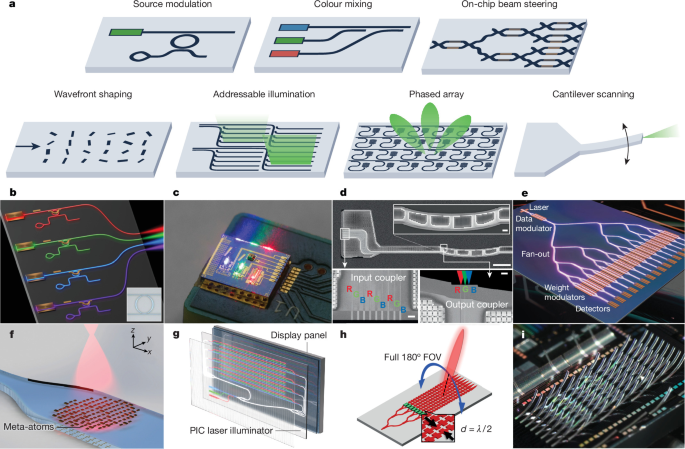
Augmented-reality (AR) glasses promise to transform how we interact with the world by seamlessly blending digital content with our physical surroundings. Yet making them viable for comfortable, all-day use remains deeply challenging, constrained by hard trade-offs of size, power and display performance. This calls for fundamentally new ways to generate and control light with high precision in an ultracompact form factor. Here we examine how integrated photonics can help bridge the technology gap in AR hardware. We review the basics of AR displays and recent advances in integrated photonics for new AR display components and architectures, then turn to key challenges and future directions, from component development to system innovation and scalable manufacturing, and highlight broader opportunities for synergy with fields such as quantum computing, bioimaging and optical sensing.
This is a preview of subscription content, access via your institution
Access Nature and 54 other Nature Portfolio journals
Get Nature+, our best-value online-access subscription
Prices may be subject to local taxes which are calculated during checkout
Baum, L. F. The Master Key: An Electrical Fairy Tale Founded upon the Mysteries of Electricity and the Optimism of Its Devotees. It Was Written for Boys, But Others May Read It (Bowen-Merrill, 1901).
Levola, T. Diffractive optics for virtual reality displays. J. Soc. Inf. Disp. 14, 467–475 (2006). The original idea of pupil replication waveguides for near-eye displays.
Sutherland, I. E. The ultimate display. In Proc. IFIP Congress Vol. 2, 506–508 (Spartan Books and Macmillan, 1965).
Xiong, J., Hsiang, E.-L., He, Z., Zhan, T. & Wu, S.-T. Augmented reality and virtual reality displays: emerging technologies and future perspectives. Light Sci. Appl. 10, 216 https://doi.org/10.1038/s41377-021-00658-8 (2021).