// NATURE NEWS — SPAZIO & SCIENZA
Enzymatic living polymerization for polysaccharide synthesis
Nature
(2026) Cite this article
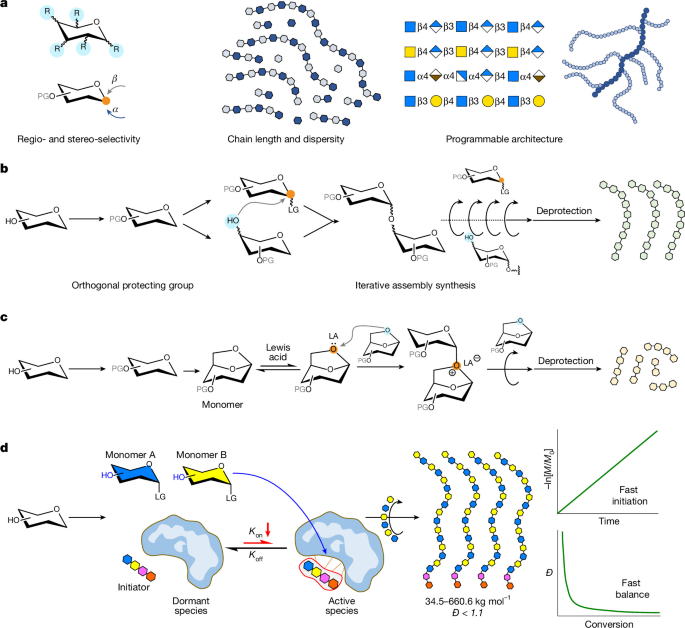
Polysaccharides have myriad functions throughout biological processes, yet synthetic access to well-defined analogues remains a challenge1,2. Achieving high molecular weight, controlled stereochemistry and sequence precision simultaneously has been elusive using conventional chemical methods that rely on protecting-group manipulations. Here we propose enzymatic living polymerization, which enables the precision preparation of natural polysaccharides with molecular weights up to 660 kg mol−1 but polydispersity from low to less than 1.05. Such a living behaviour originates from the initiator weakly binding with the polymerase, realizing fast equilibrium of the active (bound) and dormant (unbound) species, as demonstrated by mechanistic and computational studies. Our approach is generalizable to diverse polysaccharide types, including sequence-controlled block copolymers, and provides a modular route to explore molecular-weight-dependent biological functions of natural polysaccharides.
This is a preview of subscription content, access via your institution
Access Nature and 54 other Nature Portfolio journals
Get Nature+, our best-value online-access subscription
Prices may be subject to local taxes which are calculated during checkout
The data supporting the findings of this study are available in the Article and its Supplementary Information. The RNA-sequencing data generated in this study have been deposited in the Gene Expression Omnibus under accession code GSE342464. Molecular-weight characterization data for the polysaccharides studied is available at Figshare (https://doi.org/10.6084/m9.figshare.34394421)36. More data are available from the corresponding authors upon request. Source data are provided with this paper.
Su, L. et al. Carbohydrate-based macromolecular biomaterials. Chem. Rev. 121, 10950–11029 (2021).
Article
CAS
PubMed
Google Scholar
Xiao, R. & Grinstaff, M. W. Chemical synthesis of polysaccharides and polysaccharide mimetics. Prog. Polym. Sci. 74, 78–116 (2017).