// NATURE NEWS — SPAZIO & SCIENZA
Transcription from megabase-scale heterochromatin generates neural barcodes
Nature
(2026) Cite this article
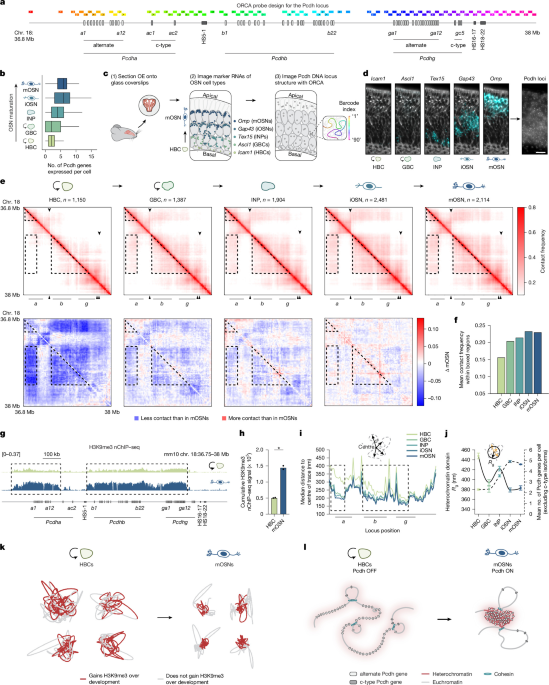
Heterochromatin typically represses genes1,2, yet some genes paradoxically require it for activation3,4,5,6,7. How can the same chromatin environment both silence and promote transcription? Here we address this question by interrogating the clustered protocadherin (Pcdh) locus, where subsets of genes are stochastically expressed while most remain silent8. In neurons, stochastic and combinatorial expression of Pcdh genes generates unique cell-surface barcodes required for self–non-self discrimination and neural circuit assembly8. By combining RNA labelling of Pcdh genes and neurodevelopmental cell types with single-molecule chromatin tracing and stochastic optical reconstruction microscopy, we find that a compact heterochromatin domain containing Pcdh genes forms as these genes become activated during development. Pcdh transcription occurs within the compact domain and reads through downstream genes, and distal enhancers must access the domain to engage target promoters. Genetic perturbations in mice suggest that opposing genome folding forces cooperate to establish Pcdh locus architecture and promote stochastic Pcdh expression. Specifically, while DNA loop extrusion allows enhancers to breach heterochromatin and find target promoters, heterochromatin-driven compartmentalization supports an expanded enhancer–promoter search space. These findings shed light on a process foundational to the development of vertebrate nervous systems and suggest a mechanism for how transcription can occur within seemingly silent chromatin environments.
Histone H3 lysine 9 (H3 K9) trimethylation, a canonical post-translational modification of constitutive heterochromatin, is known to spread over large genomic territories and repress gene expression9. These defining properties of heterochromatin were recognized in classic position–effect variegation studies in Drosophila during the 1930s, in which euchromatic genes placed near domains with trimethylated H3 K9 (H3K9me3) became transcriptionally silenced1,2. However, subsequent discovery of genes whose expression depends on their residence within heterochromatin revealed that this conflict is not absolute. For example, expression of the light (lt) and rolled (rl) genes in flies requires their position within pericentromeric heterochromatin3,4,5. In mice and humans, proper expression of olfactory receptor (OR) and KRAB domain-containing zinc-finger protein (KZFP) genes also depends on H3K9me3 heterochromatin6,7. These ‘escapee’ genes suggest the existence of specialized regulatory strategies that allow transcription to occur within, or despite, heterochromatin, raising fundamental questions about when heterochromatin facilitates versus restrains gene expression.
The vertebrate clustered protocadherin (Pcdh) locus provides a striking example of a large gene family whose expression has been proposed to require escape from a heterochromatic environment10,11,12,13. Pcdh genes are expressed predominantly in neurons, where they govern neuronal self–non-self discrimination and circuit formation8. In individual neurons, only a small subset of Pcdh genes are expressed, whereas most remain silent8. Because selection of Pcdh genes is random and combinatorial14,15,16,17, this process generates extraordinary cell surface protein isoform diversity that marks each neuron with a unique identity, or ‘barcode’. Neurites presenting the same Pcdh barcode recognize and avoid one another, thereby preventing self-adhesion, whereas neurites presenting distinct Pcdh barcodes do not self-recognize and can interact18,19,20. Consistent with their critical role in neural circuit assembly, genetic variants in Pcdh genes are associated with neurodevelopmental and neuropsychiatric disorders, including autism spectrum disorder21,22 and schizophrenia23.
In mice, there are 58 Pcdh genes distributed across three tandemly arranged clusters—α (Pcdha), β (Pcdhb) and γ (Pcdhg)—s