// NATURE NEWS — SPAZIO & SCIENZA
Structural basis of RNA-guided DNA integration by type I CAST systems
Nature
(2026) Cite this article
CRISPR-associated transposases (CASTs) achieve site-specific DNA integration by combining the RNA-guided targeting action of a nuclease-deficient CRISPR–Cas system with the assembly of a Tn7-like transpososome complex1,2. Understanding the detailed mechanisms of this elaborate process is paramount to engineering CAST systems into programmable genetic tools3,4,5,6. Type I-F Pseudoalteromonas CAST (PseCAST) shows the highest activity in mammalian cells so far7 and has been adapted extensively through directed evolution8. However, its continued rational engineering requires addressing critical gaps in our understanding of transpososome assembly and activation9. Here we perform structural analyses using cryogenic electron microscopy, validated by DNA transposition assays, to visualize the PseCAST system in a series of functional states that define the stepwise mechanism of RNA-guided DNA integration. The structures of the PseCAST targeting and transposase recruitment complexes revealed that conformational changes in the Cascade–TniQ module, induced by R-loop formation, are associated with target-DNA stabilization and TnsC heptamerization. This, in turn, results in the recruitment of the TnsAB transposase by conserved interactions with the carboxy-terminal tail of TnsB. Finally, the structure of the 1.2 MDa PseCAST transpososome holocomplex revealed allosteric coupling of TnsC–TnsB and TnsB–target-DNA interactions to the conformational remodelling of the TnsB catalytic site, activating donor-DNA integration. Together, these findings establish a unified mechanistic blueprint for RNA-guided DNA integration by type I CASTs and provide a structural framework to guide their engineering for genome-editing applications.
Transposons are pervasive DNA segments capable of mobilizing within and between genomes, thus serving as potent drivers of genome evolution and horizontal gene transfer10,11,12. CASTs have evolved repeatedly by exaptation of minimal, nuclease-deficient CRISPR–Cas systems to enable RNA-guided, site-specific DNA integration13,14,15. These systems operate through the concerted action of a CRISPR-based targeting module and a Tn7-like transposition machinery comprising the TnsC AAA+ ATPase, the TnsB transposase and, in some systems, the TnsA endonuclease. The CASTs characterized so far differ mainly in the organization of their DNA-targeting and transposition modules1,2,16,17,18. Type I variants typically use a multi-subunit Cascade–TniQ (QCascade) complex for target recognition guided by CRISPR RNA (crRNA) and TnsA–TnsB for cut-and-paste transposition19,20,21. By contrast, type V-K systems rely on the Cas12k–TniQ–S15 complex for crRNA-guided targeting5 and use only TnsB for copy-and-paste transposition, resulting in cointegrate products22. TnsC plays a pivotal part in all CASTs, acting as an adapter that bridges the targeting module and the transposase enzymes to define the insertion site23,24.
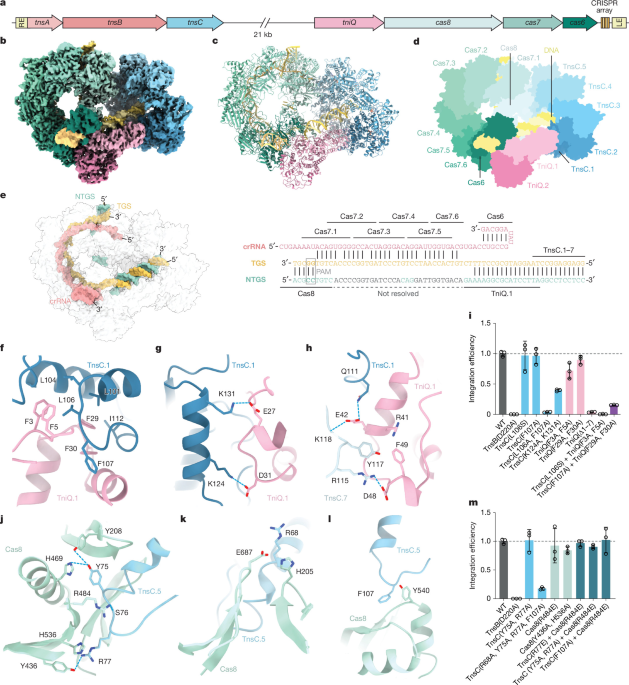
The inherent programmability of CASTs has driven their development as genome-editing tools that enable the site-specific insertion of multi-kilobase DNA cargoes without generating double-stranded breaks in the target DNA. CAST-based editing has been implemented in bacteria25,26,27,28 and mammalian cells7,8,29,30, offering considerable potential for research and therapeutic applications. Type V-K CASTs generally show low integration efficiencies in human cell lines29,30, limited specificity2,26,27,31 and heterogeneous insertion profiles22,30. By contrast, type I-F systems can perform precise, simple insertions with substantially higher efficiencies1,7,22,26. In particular, the type I-F system of the Pseudoalteromonas Tn7016 transposon (Fig. 1a) has emerged as a highly promising candidate for genome-engineering applications, because of its uniquely high integration activity in human cells7,9. Directed evolution and structure-guided engineering of PseCAST components in Escheri