// NATURE NEWS — SPAZIO & SCIENZA
Unconventional resistivity reduction in NbP semimetal nanoribbons
Nature
volume 659, pages 979–986 (2026) Cite this article
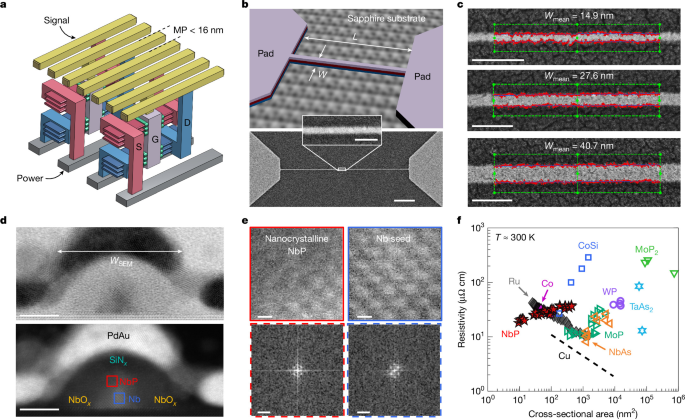
Modern and future electronics harbour a key challenge: as conventional metal wires shrink to nanoscale dimensions, their resistivity increases sharply1 owing to surface and grain-boundary scattering. To circumvent this unwanted behaviour, here, we explore the fundamental limits of charge transport in topological semimetal niobium phosphide (NbP) nanoribbons down to approximately 6-nm widths, with industry-friendly top-down nanofabrication. The extracted NbP nanoribbon resistivity reaches 18 ± 4.1 μΩ cm at room temperature with an approximately 9-nm2 cross-sectional area, lower than that of conventional metals and semimetals with comparable size. The NbP nanoribbon resistivity decreases with decreasing width, unlike the classical behaviour of metals such as copper. This trend suggests a growing relative contribution of surface and edge states as the nanoribbon cross-section is reduced, despite a certain amount of disorder, including edge roughness. Our findings advance the understanding of size-dependent transport and scaling in this class of semimetals, offering a platform for nanoscale wires and interconnects in future nanoelectronics.
This is a preview of subscription content, access via your institution
Access Nature and 54 other Nature Portfolio journals
Get Nature+, our best-value online-access subscription
Prices may be subject to local taxes which are calculated during checkout
The data that support the findings of this article are openly available in the Stanford Digital Repository at https://doi.org/10.25740/dc607yq7436.
Kim, J. S. et al. Addressing interconnect challenges for enhanced computing performance. Science 386, eadk6189 (2024).
Article
CAS
PubMed
Google Scholar
Liu, M. & Wong, H. S. P. The path to a 1-trillion-transistor GPU: AI’s boom demands new chip technology. IEEE Spectr. 61, 22–27 (2024).