// NATURE NEWS — SPAZIO & SCIENZA
Engineering signalling centres to trigger human trunk morphogenesis in vitro
Nature
(2026) Cite this article
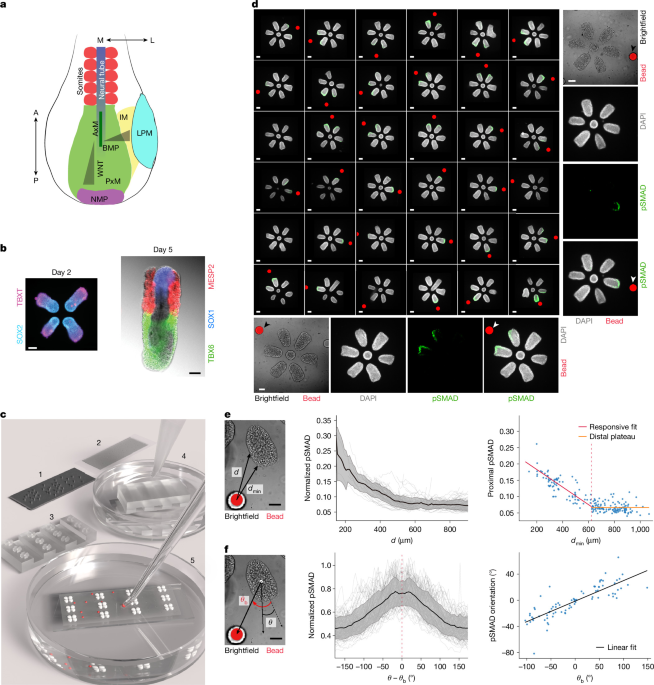
Vertebrate trunk development is orchestrated by endogenous signalling centres that generate gradients of signals such as WNT and BMP to pattern cell fates and drive morphogenesis1,2,3,4,5,6,7. Whether these cues alone can reconstitute human trunk-like morphogenesis in vitro remains unknown. Here we present a synthetic embryology platform for high-throughput, spatiotemporal delivery of morphogen signals to epithelial cysts derived from human pluripotent stem cells. Transient WNT and BMP gradients are sufficient to drive the generation of axially elongating trunk-like structures that contain a central neural tube flanked by axial, paraxial, intermediate and lateral mesoderm. The geometry of the transient BMP signal exerts lasting control over mediolateral patterning and bilateral symmetry. Patterning and morphogenesis are sustained by neuromesodermal and lateral plate mesoderm progenitors induced by the initial cues, which act as endogenous signalling centres. Together, these findings define a minimal spatial code sufficient to reconstitute trunk-like morphogenesis in a human stem-cell-based model and establish a scalable platform for studying early human development and congenital disorders.
This is a preview of subscription content, access via your institution
Access Nature and 54 other Nature Portfolio journals
Get Nature+, our best-value online-access subscription
Prices may be subject to local taxes which are calculated during checkout
The scRNA-seq and bulk RNA-seq data generated for this study are available from the GEO under accessions GSE306808 and GSE347564, respectively. Sequencing reads were aligned to the GRCh38 human reference genome (10x Genomics GRCh38-2020 for scRNA-seq; Ensembl GRCh38, assembly accession GCA_000001405.29, for bulk RNA-seq). Previously published29 human embryo scRNA-seq data are available from the GEO under accession GSE155121. Other reanalysed datasets are available from the following repositories: mouse gastrulation, ArrayExpress (E-MTAB-6967)55; cynomolgus macaque embryo, GEO (GSE193007)56; RA-gastruloid, GEO (GSE208369)57; axial organoid, GEO (GSE220563)17; axioloid, GEO (GSE199576)18; and segmentoid, GEO (GSE195467)19. GEO series are accessible at https://www.ncbi.nlm.nih.gov/geo/ and ArrayExpress experiments at https://www.ebi.ac.uk/biostudies/arrayexpress. The confocal and time-lapse datasets are large multichannel image series that are impractical to deposit in full; the measurement tables from which the quantitative imaging panels are plotted are provided in the code repository (Code availability). Raw imaging data, and any additional information required to reanalyse the data reported in this study, are available from the lead contact, S.R., on request; requests will be answered within 1 month and data shared by secure electronic file transfer without restriction. Source data are provided with this paper.
Custom code for image analysis and for bulk RNA-seq and scRNA-seq analysis—including SMD feature selection, clustering and annotation, and the trunk morph–embryo correspondence analyses—is available under the MIT License at GitHub (https://github.com/stevenzwick/zwick-2026-trunk-morphogenesis) and archived at Zenodo (https://doi.org/10.5281/zenodo.22756590)58. Random seeds and exact parameters (intensity thresholds and gates, background offsets, local-threshold window sizes, Gaussian σ, histogram edges, clustering resolutions and curated gene lists) are provided in the repository.
Wolpert, L. Positional information and the spatial pattern of cellular differentiation. J. Theor. Biol. 25, 1–47 (1969).
Article
CAS
PubMed
Google Scholar