// NATURE NEWS — SPAZIO & SCIENZA
Rare-variant genetic architecture of height in over 1.4 million individuals
Nature
(2026) Cite this article
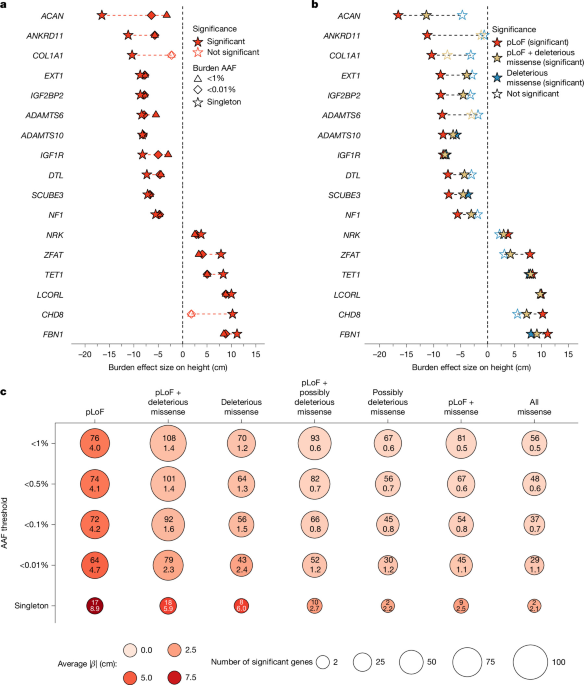
Highly heritable, polygenic and easily measured, adult height has long been the model trait in human genetics1,2. Although the landscape of height-associated common genetic variation has been studied extensively2, rare variation remains relatively unexplored1. Here, using rare protein-altering variants in a discovery set of 826,066 exomes, we identify 207 height-associated genes, 98% of which replicate in an additional 624,567 individuals. The rarest and most deleterious class of variation, singleton (frequency < 0.0001%) putative loss-of-function variants, implicated 17 genes with large effects on height ranging from −17cm (ACAN) to +11 cm (FBN1) per allele, 52× larger than the average effect of common height-associated variants and comparable to the 1% tails of a common variant polygenic score. Several genes (TET1, DTL and IGF2BP2) have effect sizes that are at least as large as established Mendelian height genes, yet lack documented stature or skeletal growth syndromes, particularly for genes associated with increased height. Our large-scale sequencing study elucidates the genetic architecture and allelic heterogeneity of rare variants in height, providing unique insights into their large effects—often similar to or larger than recognized Mendelian syndromes—and their impact on trait prediction, clinical evaluation, and discovery power to facilitate drug target prioritization.
Although height was described as a heritable trait as early as 18863, its genetic architecture started to emerge only in the late twentieth century when researchers began identifying the genetic causes of Mendelian syndromes with a substantial stature component4,5,6,7. Non-syndromic genetic modulators of height remained unclear until 2007, when genome-wide association studies (GWASs) identified the first common variants associated with height8. Fifteen years later, a GWAS of 5.3 million individuals identified 12,111 independent variants that collectively accounted for 40% of the variance in height across individuals of European descent2. As with other traits, height GWASs predominantly implicated common non-coding variants with modest effects (<1 cm)2, complicating efforts to link associations directly to specific genes and functional mechanisms.
By contrast, sequencing-based studies of rare variation can directly implicate causal genes by identifying large-effect putative loss-of-function (pLoF) and missense variants9. To systematically assess the contribution of rare coding variation to height, we performed a multiancestry exome sequencing analysis of adult height in 1,450,633 individuals across 12 cohorts (Supplementary Table 1), in which we (1) identified 17 height-associated genes through a burden of singleton pLoFs; (2) identified additional height-associated genes by including nonsynonymous variants up to 1% alternate allele frequency (AAF) and applying non-burden tests that do not assume variant effects act in the same direction; and (3) estimated the impact of rare protein-altering variation on genetic-based height prediction.
Using 826,066 individuals from six cohorts (Supplementary Table 1), we performed three discovery association analyses of adult height: (1) imputed common variants (AAF > 0.01); (2) rare exome variants (AAF ≤ 0.01, alternate allele count (AAC) ≥ 10); and (3) gene-based tests grouping rare coding variants. We used a single unified Bonferroni significance threshold of 1.75 × 10⁻⁹ across all three analyses (Methods). For gene-based analyses, we used a gene-wide omnibus statistic, gene-P10, that aggregates evidence across burden tests and two other gene-based tests, variant-level aggregate Cauchy association tests (ACAT-V)11 and optimal sequence kernel association tests (SKAT-O)12 (Methods and Supplementary Fig. 1). We used six additional cohorts with 624,567 individuals for replication (Supplementary Table 1) and assessed the impact of rare variants on height