// SPACE.COM — SPAZIO & SCIENZA
BALLS on the moon: China set to launch Africa's 1st lunar science mission in 2029
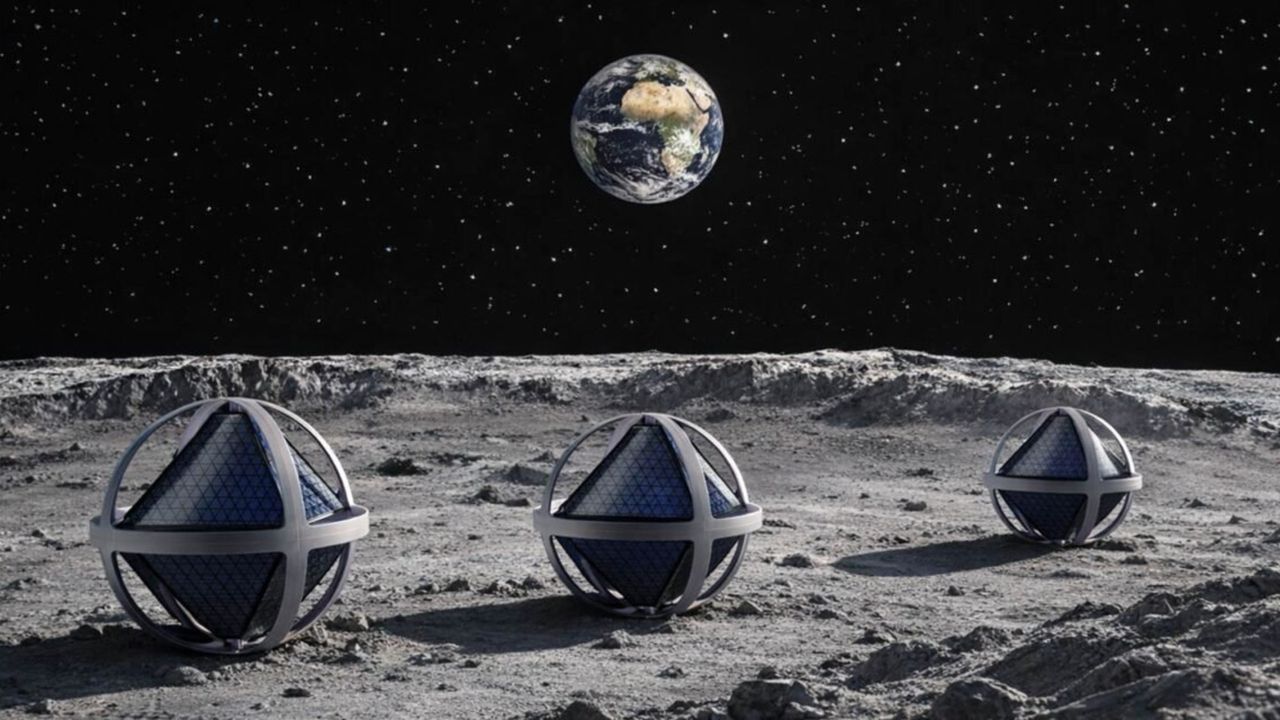
"If this is successful, it will ignite the reality of space on the African continent."
When you purchase through links on our site, we may earn an affiliate commission. Here’s how it works.
China's Chang'e-8 moon lander mission scheduled for 2029 could send Africa's first space exploration mission to the lunar south pole.
Under the Africa2Moon venture, the Bounced African Low Lunar Sphere, or BALLS for short, is a technology demonstrator in which a trio of spherical probes on the lunar surface will form a radio astronomy array at the moon's south pole region. Each of the metal spheres contains low-frequency radio telescope antennas that will search for signals from some of the oldest and most distant parts of the universe.
Astronomers say the lunar far side is the most radio-quiet site in Earth's vicinity, a location perfect for "listening" to the universe without interference. The BALLS array will work together to observe low frequency radio signals from space that are not observable from the surface of the Earth, according to Carla Mitchell, mission director of the Africa2Moon initiative and Africa Program manager at the South African Radio Astronomy Observatory (SARAO). The moon is an ideal place to perform such studies, they said, as the low frequency signals to be measured are unobservable from Earth due to interference created by our planet's atmosphere.
The Africa2Moon project was selected by the Chinese National Space Administration in April 2025 as one of nearly a dozen of Chang'e-8's international payloads.
BALLS will enable observations below 20 megahertz (MHz) that are inaccessible from Earth due to ionospheric distortion and radio interference. Low-frequency radio waves (below about 50 MHz) come from some of the oldest and most distant parts of the universe.
The BALLS array will serve as pathfinder hardware for future lunar technologies and radio astronomy experiments. They will also act as a technology demonstrator for the full Africa2Moon mission, which plans for an array of 55 antennas to be deployed on the far side of the moon.
"As a little girl I thought space was not possible for people in Africa. I never thought I would be here today, presenting our lunar mission at NASA," said Mitchell.
Mitchell detailed years of team work on the BALLS initiative, rolling forward from paperwork to hardware, speaking July 22 at the NASA Exploration Science Forum 2026, held at NASA's Ames Research Center and staged by the NASA Solar System Exploration Research Virtual Institute (SSERVI).