// BBC WORLD NEWS — MONDO
What will happen when a SpaceX rocket collides with the Moon?
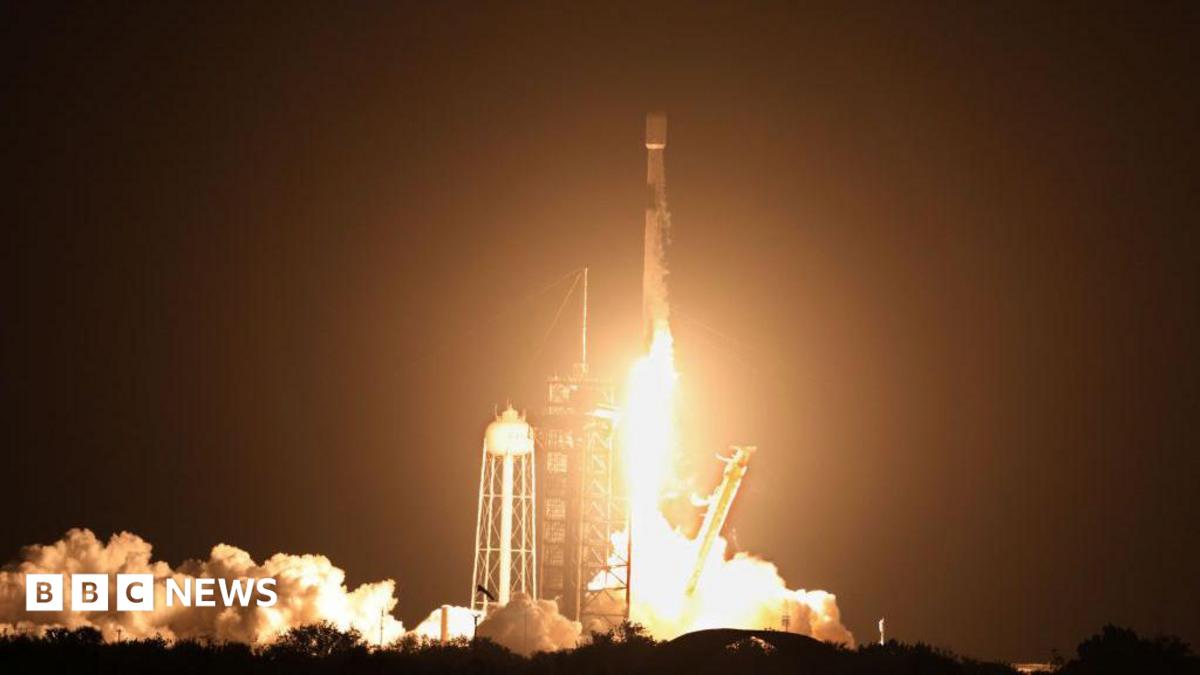
The rocket component that will strike the Moon is the upper section of a SpaceX Falcon 9
The Moon has endured countless blows over millions of years. Asteroids and meteors have given the satellite its signature pockmarked surface and network of craters. More recently, it has also experienced impacts from the plucky little probes and landers that Earthbound space agencies have sent hurtling its way.
Now on Wednesday, scientists expect the Moon will experience yet another collision, this time from a drifting SpaceX rocket that has been travelling at around 2.43 kilometres per second, or about 5,400mph.
The upper stage (section) of one of SpaceX's Falcon 9 rockets will "impact" the Moon on 5 August, according to Nasa's Centre for Near-Earth Object Studies (CNEOS).
The US space agency reached the conclusion after independent astronomers, using public data, noted that a portion of the rocket from a January 2025 launch was on an accidental collision course with the Moon.
"There is no danger to Earth," said spokesperson Jimi Russell. "Nasa will continue to track the booster for training purposes, as well as later observe the impact site for scientific purposes."
SpaceX launched this specific Falcon 9 rocket as part of a US and Japanese mission to carry a pair of lunar landers and scientific equipment to the Moon last year.
Part of the Falcon 9 is reusable and designed to return back to Earth for its next mission. But parts of the rocket are shed in space and remain there, stuck in orbit unless they eventually collide with another celestial body.
The piece in question is the upper stage of the rocket, and is about the size of a five-storey building, with a weight on Earth of at least 4,000kg (8,800 lbs).
Astronomer Bill Gray, who first discovered the trajectory, says the object will land near the Einstein Crater, which is on the part of the Moon that receives daylight and is visible from Earth. He predicts it will create a crater more than 17m (56ft) in diameter.