// SPACE.COM — SPAZIO & SCIENZA
Astronomers solve the mystery of black holes' delayed cosmic 'burps'
"These late-time radio burps can appear when the black hole eats too fast or eats too slowly, so you should always eat the right speed if you want to avoid indigestion."
When you purchase through links on our site, we may earn an affiliate commission. Here’s how it works.
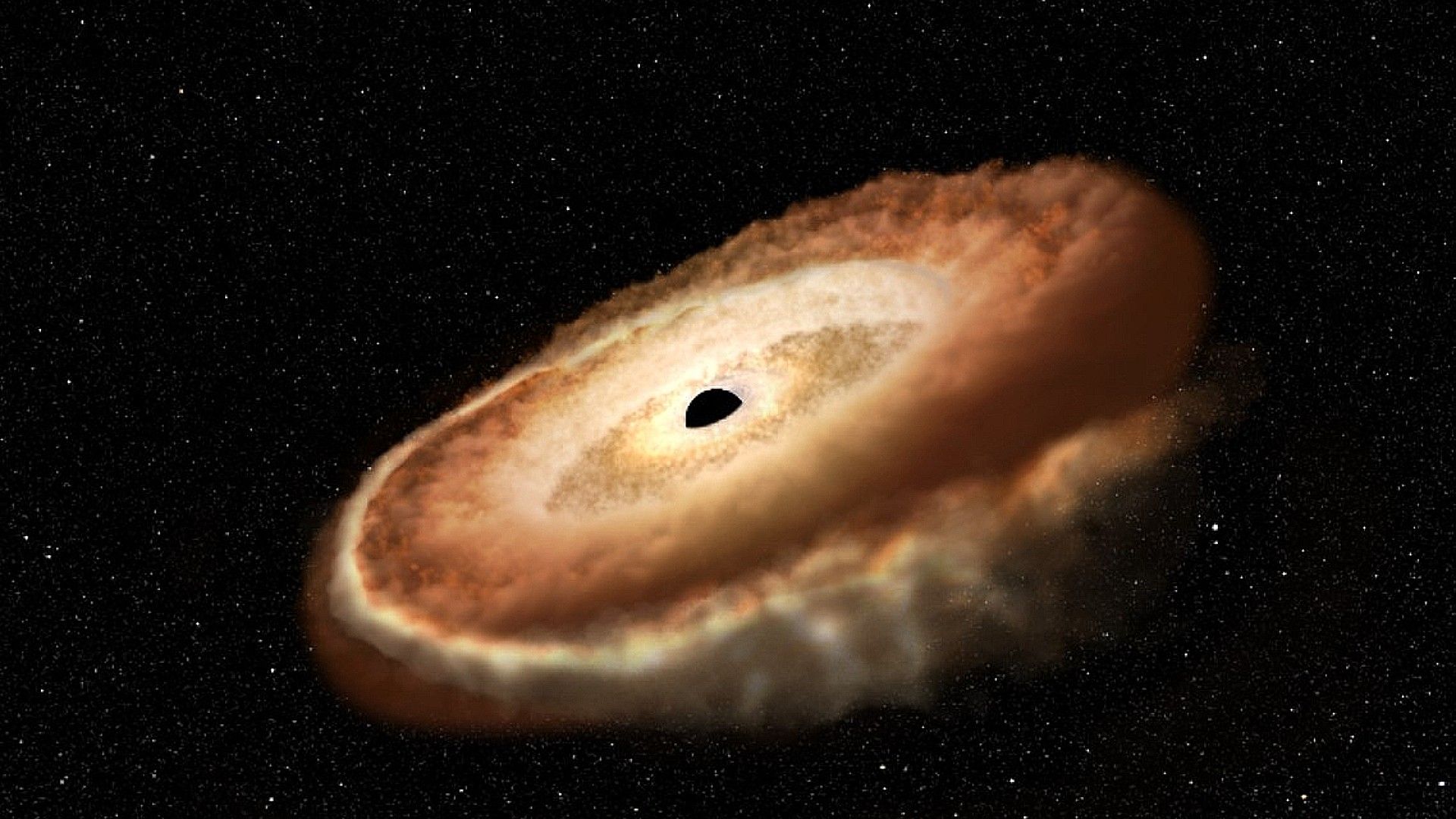
Supermassive black holes are notoriously messy when devouring a star, but they can also linger over their meals, letting out massive radio "burps" months or even years after their cosmic feast appears finished.
Now, scientists tracking these events have found there is no one-size-fits-all model for how black holes digest stellar material. Speaking Monday (June 15) at the 248th meeting of the American Astronomical Society in California, Kate Alexander, an astronomer at the University of Arizona who has been studying these events, said the behavior depends instead on their shifting dietary phases.
"Sometimes, after it seems like they are done eating, they may get indigestion and they may let out a large radio 'burp,'" Alexander said during a press conference on Monday. "These late-time radio burps can appear when the black hole eats too fast or eats too slowly, so you should always eat the right speed if you want to avoid indigestion."
Her recent research focuses on Tidal Disruption Events, or TDEs, which are cosmic catastrophes that occur when an unlucky star wanders too close to a supermassive black hole. As the star nears the behemoth, intense gravitational fields shred it into a spaghetti-like stream of gas debris in a process known as "spaghettification."
Because these events are rare, occurring roughly once every 100,000 years in any given galaxy, astronomers must monitor a large number of galaxies just to spot them. Historically, targeted radio follow-up of these disruptions ceased if no emission was detected within the first year or so, leaving their long-term behavior unstudied.
"When we first started looking at them, we just stopped looking," she said. "But, it turns out that we should have kept looking, because this is often when some of the most really interesting things are happening."
Over the past six years, astronomers have been using the Karl G. Jansky Very Large Array (VLA) telescope in New Mexico to conduct the first large-scale, systematic radio observations of several dozen nearby TDEs. A 2024 paper, by radio astronomer Yvette Cendes of the University of Oregon and co-authored by Alexander, first reported that roughly 40% of all TDEs are detected in radio months to years after the initial disruption, long after the visible light has dimmed.
Now, published this year in The Astrophysical Journal, the new study led by Alexander sets out to explain why these long-dormant systems reactivate. To solve the mystery, the researchers combed through decades of data, analyzing 91 TDE candidates discovered between 1990 and 2019 before narrowing their focus to a gold-standard sample of 31 events with comprehensive, multiwavelength tracking.