// SPACE.COM — SPAZIO & SCIENZA
NASA's SkyFall Mars helicopters will wear tiny capes
When you purchase through links on our site, we may earn an affiliate commission. Here’s how it works.
Picture it: A swarm of tiny robot helicopters descends through a reddish-brown sky, landing gracefully on the Martian surface. What are they wearing? Tiny capes.
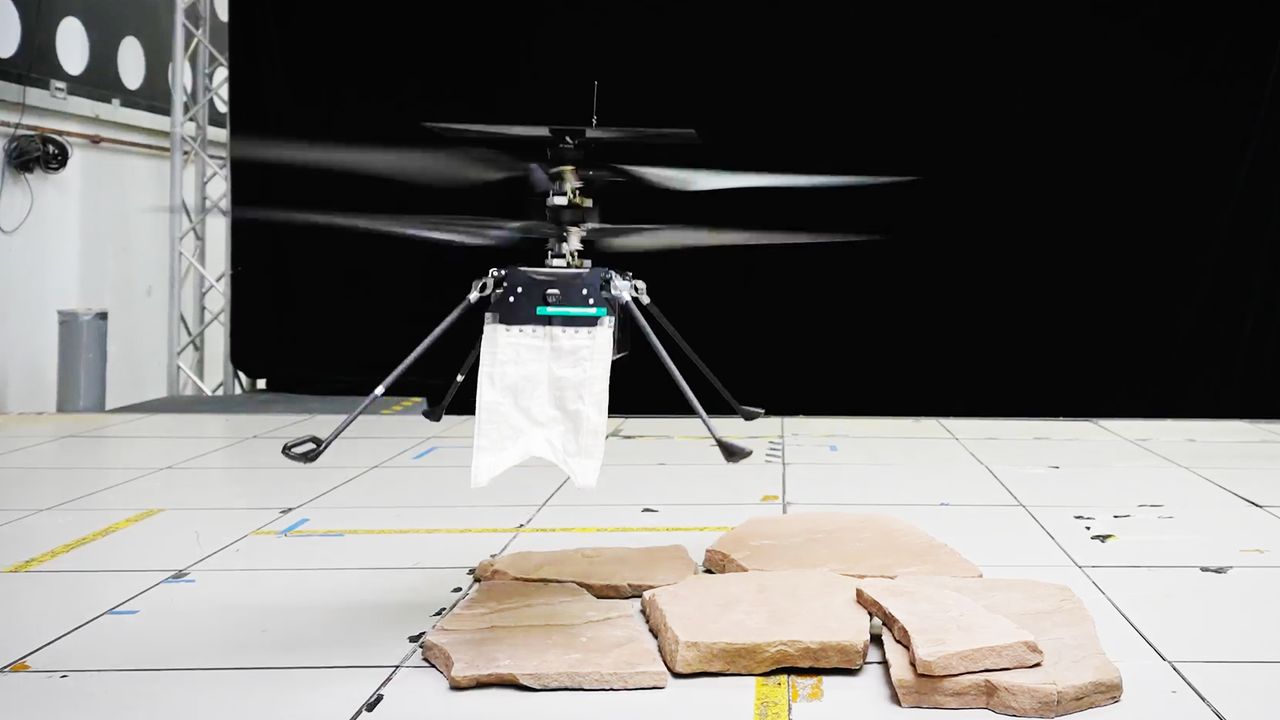
NASA's SkyFall mission will send a trio of mini rotorcraft to Mars equipped with ground penetrating radar technology which happens to look like little capes. These uniquely designed swaths of fabric look decidedly strange or even accidental in new videos from NASA's Jet Propulsion Laboratory (JPL) that show the little drones practice landing. But these capes are actually flexible antennae that will allow the craft to peer beneath the Red Planet's surface in search of water ice.
"The only way to detect shallow subsurface ice remotely is to fly close to the ground," Adrian Tang, SkyFall’s ground-penetrating radar lead instrument scientist at JPL, said in a statement on Thursday (Aug. 6). "By flying low and slow, a SkyFall helicopter could capture radar images that resolve the fine layering where dry soil gives way to ice, detecting its presence and mapping its extent."
Orbiting spacecraft have studied Mars for decades, imaging the planet and mapping it with radar. But from orbit, their radar is unable to see the first few feet of material just below the planet's surface — a zone where scientists expect to find shallow ice deposits mixed in with the rocks and dust. This work could be important for future astronauts who need to better understand the ground below their feet for safety reasons, and for future travelers searching for accessible ice to process for drinking water, oxygen and fuel.
Skyfall will follow in the footsteps of Ingenuity, the first rotorcraft on another world, which hitched a ride to Mars aboard NASA's Perseverance rover. The new choppers are based heavily on Ingenuity, which weighed just 4 pounds (1.8 kilograms) here on Earth. But Skyfall will be more capable than Ingenuity, whose main job was to show that choppers can explore the thin skies of Mars.
SkyFall's tiny cape ground-penetrating radar, which uses a type of flexible antenna called Vivaldi that was invented back in 1978, is designed to survey up to 16 feet (5 meters) below the Martian surface. The radar will be able to reach anywhere from several yards below the planet's surface to the uppermost layers of surface material.
And the antenna's unique design ensures that the SkyFall drones will be able to make these subsurface observations without damaging the equipment during landing.. The antenna is extremely lightweight, and the team miniaturized it to be both the right size and shape to fit the tiny helicopters, which sit just 6 inches (15 centimeters) above the ground at rest. The tricky thing was, the designers had to miniaturize the radar antennae while maintaining functionality. But they did just that, and these tiny radar capes will be able to bend and move out of the way as the rotorcraft do their thing, flying above and landing on the Red Planet.
"Although we managed to shrink the antenna quite a bit, it is about 1.5 times longer than the helicopter’s legs," Christine Gebara, SkyFall ground-penetrating radar mechanical lead at JPL, added in the statement.
"That means during landing, the Vivaldi has to bend out of the way — and if it lands on a rock, it bends even further," she added. "But when the helicopter takes off again, the antenna must spring back into place for data collection. Because SkyFall is expected to make dozens of flights exploring Mars, we needed an antenna that could repeatedly handle those pressures without losing its shape in flight."