// TOM'S HARDWARE US — HARDWARE & GADGET
Intel Core Ultra 7 270K Plus vs AMD Ryzen 7 7700X3D faceoff — battle of the upper mid-range CPUs
When you purchase through links on our site, we may earn an affiliate commission. Here’s how it works.
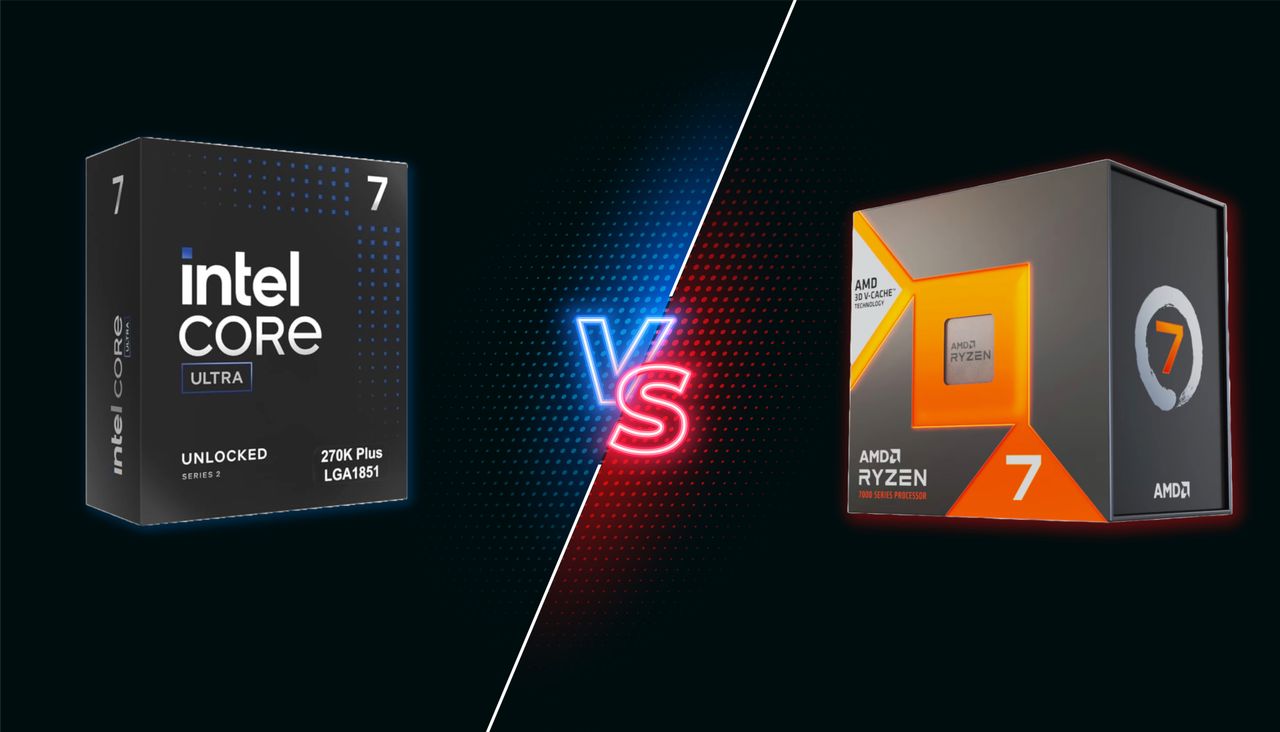
The mid-range CPU segment has become more competitive than ever, with both Intel and AMD refreshing their lineups and pushing aggressive pricing. In one corner, we have the Intel Core Ultra 7 270K Plus, an important reset for Intel that prioritizes class-leading productivity performance over efficiency, while also offering solid value. In the other corner is AMD's newly launched Ryzen 7 7700X3D, a more affordable, slightly lower-clocked alternative to the 7800X3D.
This faceoff is particularly interesting because the two chips take very different approaches despite costing about the same price. The Core Ultra 7 270K Plus packs 24 cores and excels in productivity workloads, while also delivering Intel's strongest gaming performance in years. The Ryzen 7 7700X3D, meanwhile, relies on AMD's proven 3D V-Cache technology to deliver gaming performance within 5% of the 7800X3D, although it trails significantly in single- and multi-threaded workloads.
While the Ryzen 7 7700X3D is aimed at gamers looking for X3D performance at a lower price, it faces stiff competition from Intel's aggressively -priced Core Ultra 7 270K Plus, as well as its own sibling, the Ryzen 7 7800X3D, which is often available for only a little more.
So, is AMD's gaming-focused approach enough to beat Intel's well-rounded Arrow Lake Refresh processor, or has Intel finally found the right balance of price and performance to reclaim the mid-range crown? In this six-round faceoff, we compare these two sub-$350 CPUs to find out which one comes out on top.
Taking a look at the technical specifications, it's clear that each chip adopts a distinct strategy for the mid-range market. While Intel has optimized its architecture for a higher core and thread count along with improved interconnect speeds, AMD continues to leverage its stacked cache to maintain gaming dominance on a long-lived platform.
The Intel Core Ultra 7 270K Plus is based on the original Arrow Lake-S family, utilizing the same microarchitecture that we saw on the 265K, built using TSMC’s 3nm process. It matches the flagship 285K with a 24-core configuration (8 Lion Cove P-cores and 16 Skymont E-cores) and operates with a 125W TDP. The chip can scale to a 250W Maximum Turbo Power (MTP), which is the maximum power limit that this CPU can consume for short periods when running at maximum turbo boost frequencies
Intel has also standardized several enthusiast-level performance tweaks for Arrow Lake Refresh, most notably a 900 MHz increase in die-to-die frequency and a 400 MHz fabric speed boost. It also officially supports faster DDR5-7200, along with 20 lanes of PCIe Gen 5 and 76MB of total cache. Possibly the only major concern with the Core Ultra 7 270K Plus is the LGA 1851 platform. With Intel's next-generation Nova Lake processors expected to launch later this year, the current platform will have a relatively short lifespan, restricting any future upgrade options.
Get Tom's Hardware's best news and in-depth reviews, straight to your inbox.
The AMD Ryzen 7 7700X3D serves as a more affordable, lower-clocked variant of the 7800X3D, featuring the same eight Zen 4 cores with a peak boost clock of 4.5 GHz. Its primary architectural strength is its 104MB of total cache including 64MB of vertically stacked L3, which is specifically tuned to eliminate memory latency bottlenecks.