// NATURE NEWS — SPAZIO & SCIENZA
A gas-enshrouded and gas-reddened black hole at cosmic dawn
Nature
volume 656, pages 329–333 (2026) Cite this article
The physical processes that led to the formation of billion-solar-mass black holes within the first 700 million years of cosmic time, a period known as cosmic dawn, remain a puzzle1. Several theoretical scenarios have been proposed to seed and rapidly grow black holes2,3,4, but direct observations of these mechanisms remain elusive. Here we present a source 660 million years after the Big Bang that exhibits singular properties: among the largest hydrogen Balmer breaks reported at any redshift, broad multi-peaked Hβ emission, and Balmer line absorption in several transitions. We model this source as an enshrouded black hole in which the Balmer break and absorption features are a result of extremely dense, turbulent gas forming a dust-free envelope around a supermassive black hole5,6. This source may provide evidence of an early black hole embedded in dense gas—a theoretical configuration proposed to rapidly grow black holes by super-Eddington accretion7,8. Radiation from the black hole seems to dominate almost all observed light, leaving limited room for contribution from its host galaxy. If the source merged with its brighter neighbour, it would resemble the recently discovered ‘little red dots’ with perplexing spectral energy distributions9,10,11. The redness of the black hole is due to gas, not dust12,13, and scattering, not kinematics, gives rise to the complex line shapes and luminosities—black hole masses of these sources may therefore be overestimated by orders of magnitude.
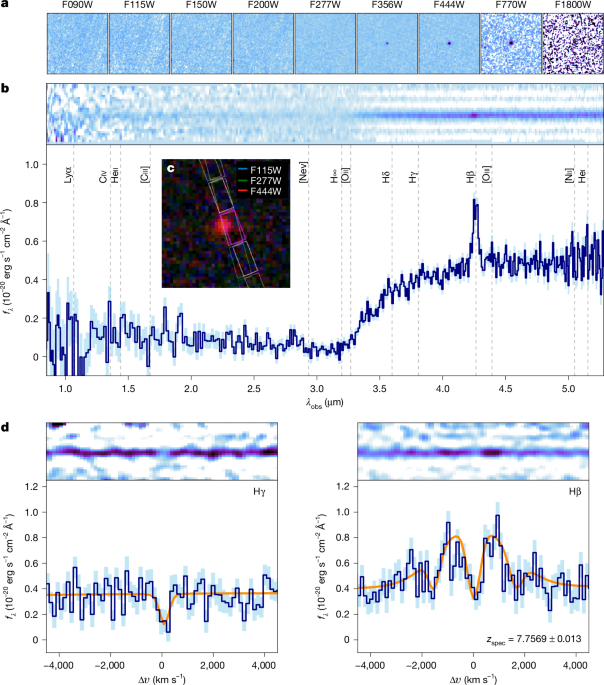
We recently observed MoM-BH*-1 with the NIRSpec instrument of JWSTas part of the ‘Mirage or Miracle’ (MoM) JWST program (GO-5224). MoM-BH*-1 was selected as a high-priority target for spectroscopic follow-up based on its striking appearance in NIRCam images of the Ultra Deep Survey (UDS) extragalactic field14. It stood out as the reddest source in this approximately 250 arcmin2 field (F277W-F356W > 2.5 mag), appearing remarkably luminous (F444W = 25.4 mag) and unresolved at >3 μm, while apparently disappearing at shorter wavelengths (F200W > 28.5 at 3σ; Fig. 1a).
a, The 3 × 3″ NIRCam and MIRI images of MoM-BH*-1 spanning 0.9–18 μm. The source is point-like and detected (>3σ) only in the F356W, F444W and F770W bands, apparently disappearing in the bluer bands. b, The NIRSpec prism spectrum (dark blue) shows that the disappearance is due to an enormous Balmer break. Key spectral features such as the Balmer series are marked with dashed lines. c, The 1″ RGB image shows the almost identical slit positions with which the source was observed with the prism (b) and G395M grating (d). d, Deep absorption features in Hγ and Hβ are evident in the G395M grating spectra. The location of the central absorption is consistent across both Hβ and Hγ as well as across the prism and grating spectra. The systemic redshift is based on the [Oiii] 4,960, 5,008 Å doublet. A representative draw from the emission line model posterior is plotted in orange (Methods).
Figure 1b shows the 4.5-h deep NIRSpec prism spectrum obtained (R ≈ 150, about 1−5 μm; 15 December 2024). Figure 1d shows a public archival 1.5-h NIRSpec G395M spectrum taken by the EXCELS survey15 (R ≈ 1,500, about 3−5 μm; 19 December 2023). The redshift (\({z}_{{\rm{spec}}}=7.756{9}_{-0.0012}^{+0.0013}\)) is confirmed by several features: a broad Hβ emission line (\(\mathrm{FWHM}=3,03{6}_{-506}^{+361}\,\mathrm{km}\,{{\rm{s}}}^{-1}\)), Hγ absorption at the same redshift as deep Hβ absorption and a strong Balmer break between 3 μm and 4 μm, where the flux drops by a factor of >20×, thereby explaining the extremely red NIRCam colour (\({f}_{\mathrm{F444W}}^{\nu }/{f}_{\mathrm{F277W}}^{\nu } > 20\)). A narrow [Oiii]4,960, 5,008 Å doublet is detected (3.5σ) at a redshift consistent with the Balmer lines.
The strength of the Balmer break is remarkable. In Fig. 2, we compare MoM-BH*-1 with objects exhibiting Balmer breaks at simila