// NATURE NEWS — SPAZIO & SCIENZA
Biomarkers of nivolumab benefit in resectable non-small cell lung cancer
Nature
(2026) Cite this article
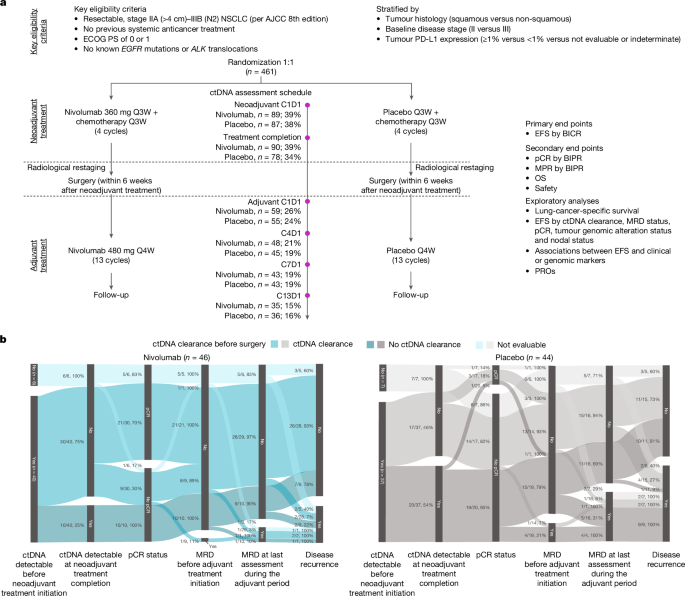
Perioperative nivolumab significantly improved event-free survival (EFS) compared with placebo in patients with resectable non-small cell lung cancer (NSCLC) in the CheckMate 77T study (ClinicalTrials.gov NCT04025879)1. Here, after randomization, 98 out of 229 patients who received nivolumab and 92 out of 232 patients who received placebo had evaluable biomarkers (41% of randomized patients). Of the 98 patients receiving nivolumab, 83 (85%) had detectable circulating tumour DNA (ctDNA) before initiating neoadjuvant treatment and 90 (92%) at neoadjuvant treatment completion. Of the 92 placebo-treated patients, 75 (82%) had detectable ctDNA at the treatment start and 78 (85%) at completion. Among the 98 nivolumab-treated patients, 76 (78%) had detectable and evaluable ctDNA before and after neoadjuvant treatment, and 50 of them (66%) had pre-surgical ctDNA clearance, and 25 out of 50 (50%) had pathologic complete response (pCR). For the placebo-treated group, these values were 64 out 92 (70%) for detectable and evaluable ctDNA before and after neoadjuvant treatment, and 24 out of 64 (38%) had pre-surgical ctDNA clearance, and 3 out of 24 (12%) had pCR. Furthermore, 4 out of 48 (8%) patients in the nivolumab group and 9 out of 44 (20%) in the placebo group who were negative for molecular residual disease (MRD) after surgery and before adjuvant treatment initiation became positive during the adjuvant treatment period; all had disease recurrence. EFS seemed to be prolonged with nivolumab (n = 60) versus placebo (n = 45) in patients with single or co-alterations in any of the KEAP1, STK11, CDKN2A and/or SMARCA4 driver genes (hazard ratio, 0.48; 95% confidence interval, 0.28–0.83). In a machine-learning model trained using biomarker-evaluable patients, top predictors of prolonged EFS included pre-surgical ctDNA clearance, non-N2 NSCLC, pCR, squamous tumour histology and nivolumab treatment. These findings provide insights into predictive markers for outcomes with perioperative nivolumab in resectable NSCLC.
Neoadjuvant nivolumab plus platinum-doublet chemotherapy is an established standard-of-care treatment for eligible patients with resectable NSCLC based on the results of the phase III CheckMate 816 study. Data from this trial demonstrated significant and clinically meaningful improvements in pCR, EFS and overall survival (OS) versus chemotherapy alone2,3. The phase III CheckMate 77T study (NCT04025879) built on these findings and demonstrated significant and clinically meaningful EFS benefit with nivolumab administered in combination with platinum-doublet chemotherapy before surgery and as a single agent after surgery (that is, perioperative nivolumab) versus placebo (hazard ratio (HR), 0.58; 97.36% confidence interval (CI), 0.42–0.81; P < 0.001) among patients with stage IIA–IIIB resectable NSCLC1. Improved pCR rates were also observed in the nivolumab arm (25.3%) versus the placebo arm (4.7%)1. On the basis of these results, perioperative nivolumab was approved in the USA, the European Union and other countries for eligible patients with resectable NSCLC4,5,6,7. Clinical benefit with perioperative immunotherapy has also been demonstrated in other phase III studies, such as KEYNOTE-671, AEGEAN and RATIONALE-315, which found that perioperative pembrolizumab, durvalumab and tislelizumab, respectively, significantly improved EFS and pCR rates compared with placebo8,9,10,11,12,13. Perioperative pembrolizumab and tislelizumab were also shown to significantly improve OS11,13.
Immunotherapy-based treatments have demonstrated clinical benefit in patients with resectable NSCLC with clinical and/or genomic markers associated with poor prognoses. Patients with detectable ctDNA, molecular residual disease (MRD) and absence of pCR seem to have worse survival outcomes owing to persistent disease. By contrast, neoadjuvant2,3 and perioperative14,15,16,17,18 immunotherapy-based treat