// NATURE NEWS — SPAZIO & SCIENZA
‘Little red dot’ gets its colour from gas — not dust
Dominik Schleicher is in the Department of Physics, Sapienza University of Rome, Rome 00185, Italy.
Search author on:
PubMed
Google Scholar
Rodrigo Herrera-Camus is in the Department of Astronomy, University of Concepción, Concepción, Chile, and the Millennium Nucleus for Galaxies (MINGAL), Concepción, Chile.
Search author on:
PubMed
Google Scholar
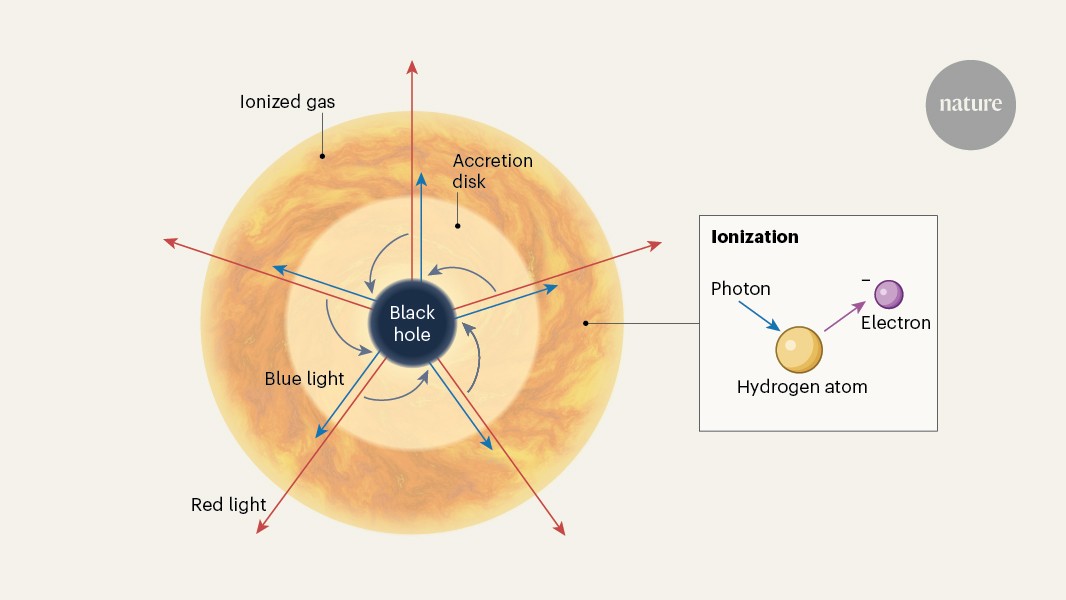
Dust, which is found throughout the Universe, absorbs and scatters blue light more efficiently than it does red, so astronomical objects often look reddened when observed from Earth. The reddening of light by dust underpins most theories about little red dots (LRDs)1,2, which are bright, compact astronomical objects with unknown origins. But now, in a paper in Nature, Naidu et al.3 report the discovery of an LRD with spectral properties that might be explained by a large cloud of dense, ionized gas, rather than dust. The authors argue that if other LRDs are gas-reddened, their true masses might be substantially smaller than previously estimated.
Access Nature and 54 other Nature Portfolio journals
Get Nature+, our best-value online-access subscription
Prices may be subject to local taxes which are calculated during checkout
Article
PubMed
Google Scholar
Liempi, M. et al. Astron. Astrophys. 708, A44 (2026).