// KOTAKU — GAMING
I Am Looking For My Father In Blue Prince’s Spiral Of Stars
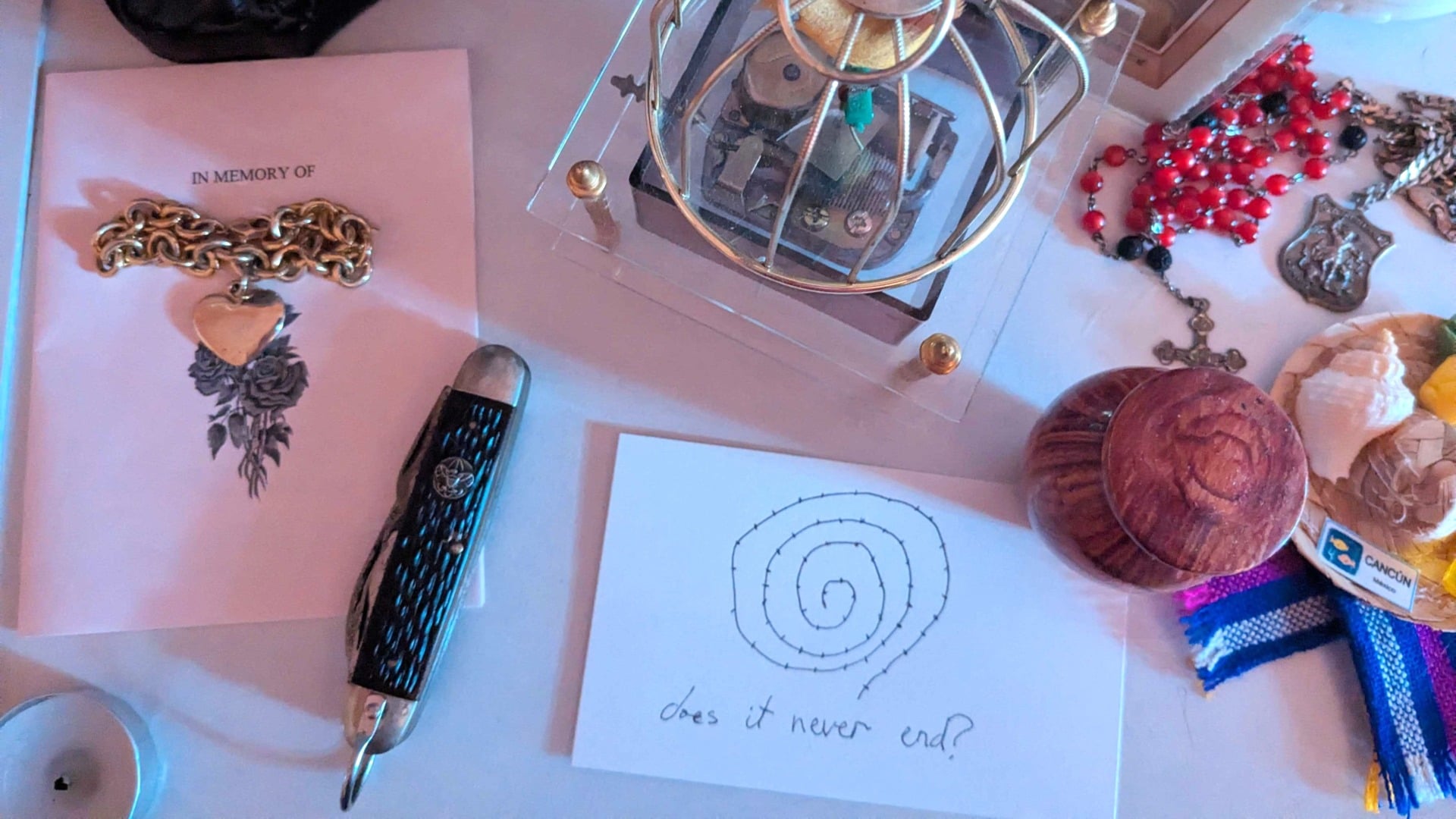
This piece contains spoilers for the entirety of Blue Prince.
Blue Prince does not have a clear, clean-cut ending. It has a number of stopping places where one can choose to walk away, such as when the player finds Room 46 or when they discover the secret will of Baroness Auravei. But no single one of those moments constitutes what I’d call an “ending,” because even when every room is unlocked, every clue examined, every blueprint drafted, Blue Prince still taunts you with unsolved mysteries. What is the Spiral of Stars? What happened to the eighth red envelope? What does SWNSNG mean? What about the cryptic note in the Clocktower?
Simon, the game’s player character, is a silent protagonist, and with no one for him to interact with it’s very difficult to understand what his own, personal feelings toward the mysteries of Mount Holly must be. But one must imagine that from the start, even before the player knows his history, he’s entering the manor hoping to find some trace of his lost mother. Throughout his drafting adventures, Simon finds pieces of her. He finds the children’s book she wrote for him, clues to her heritage, leftover remnants of her political resistance and suggestions that she hoped he would take up the mantle after her. We learn that she fled Orinda Ares, but the trail goes cold from there. She never reappears in the story. There’s no happy ending, no answer for Simon, or for us, as to whether Mary is even alive or dead.
Even after I’d seen all there was to see I persisted in playing Blue Prince for hours, hoping there might be one last secret I was missing, some resolution I had not yet come to that would answer the question of Mary’s fate. How could a game all about finding answers end with no answer to one of its most pressing questions? I scoured every clue that hadn’t unlocked something yet. I joined Discords, read forums, did absurd drafting experiments, looked for hidden letters in the walls. I pored over the game’s mysterious spirals, the note left by Lady Clara: “Does it never end?” I wanted it to, because I like games with satisfying conclusions. A tearful reunion, or an outpouring of grief perhaps. This was neither of those. It surely could not be the end of the journey. I could not leave Simon with a giant, gaping hole where Mary Jones had once stood, and no way to ever know whether she lived, died, or even still cared for him.
When I played Blue Prince, I didn’t think of it as a story about grief. Spelling it out like this, it seems stupidly obvious. I didn’t even consider it until I accidentally used it as a metaphor to explain my feelings about my father’s death to my therapist. I was explaining to her the long process I’ve undergone over the last year of trying to unravel the mystery of my father: who he was, why he was the way he was, and why he died in the sad, stupid way that he did. The answers I was finding were boring, unhelpful, depressing, or nonexistent. I wanted there to be more—I wanted there to be some deeper explanation, some tidy sentence or two with which I could explain my father to myself that would wrap it all up in a bow and allow me to get this whole “grieving” thing over with. Of course, there is not, and never will be. But what if I just kept looking a little bit longer?
My dad’s story wasn’t a happy one. I didn’t realize just how unhappy it all was until after his death, because he literally never talked about himself, his family, his history, or his internal life. He lost his father to suicide as a teenager, both of his sisters too young to complications of substance abuse, and had a deeply unpleasant relationship with my mother. He was good to me, mostly. My fuzzy childhood memories of him are, I think, normal, even pleasant. He took me to baseball games, made up silly songs for me, helped me with math homework, surprised me with sweets. But sometime after I moved out of the house, he began to change.
Mental health troubles ran in his family, and he came from an er