// HACKER NEWS — CYBERSECURITY
GPT 5.6 Sol is the best "vision" model OpenAI ever released
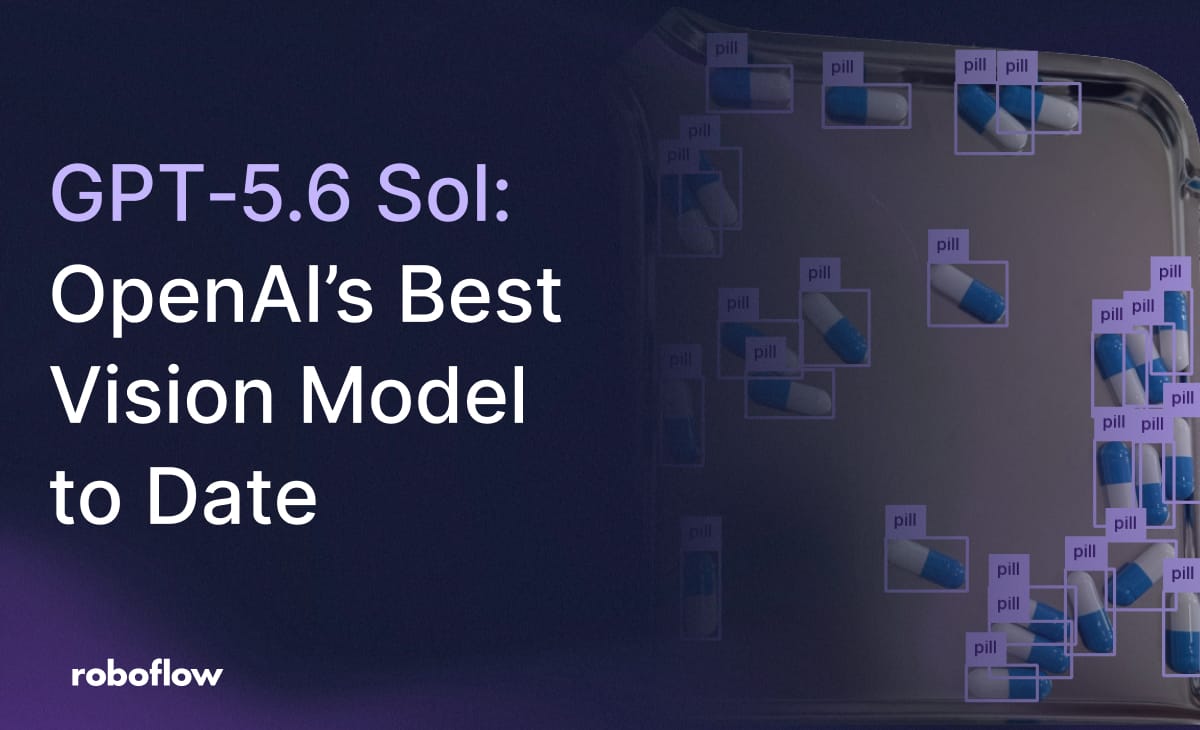
Last week, OpenAI announced the GPT-5.6 lineup, introducing the Sol, Terra, and Luna models. During the release stream, the team focused heavily on computer use, showing models capable of navigating and operating desktop applications. OpenAI highlighted UI agents and detailed 3D visualizations, but both depend on stronger visual understanding.
To measure their vision capabilities, we ran the models through our upcoming VLM benchmark, which we plan to release in the next few weeks. The benchmark covers common vision tasks, including detection, counting, OCR, and data extraction. In this post, we take a closer look at how GPT-5.6 performs across each of them.
Sol is clearly the best vision model OpenAI has released so far. The jump is especially visible in object detection and counting, where GPT-5.5 was far behind the strongest VLMs. Terra and Luna are not as strong as Sol, but both show meaningful progress over GPT-5.5.
Test Sol, Terra, and Luna in Roboflow Playground and compare their results with models such as Claude Fable 5 and Gemini 3.5 Flash across the same vision tasks.
Detection is where GPT-5.6 shows the clearest jump. GPT-5.5 scored 13.8 mAP@50 in our benchmark, while Sol reached 46.2. Terra and Luna followed closely at 44.7 and 43.3, moving object detection from a major weakness to a practical capability.
Document layout detection is one of the clearest strengths of GPT-5.6. Sol handled titles, paragraphs, tables, images, and signatures well. Many document workflows start with locating the relevant parts of a page before OCR or data extraction begins.
GPT-5.6 also performed well on dense scenes. The pills and eggs examples contain many similar objects packed closely together, a common weakness for VLM-based detection. Unlike traditional detectors, VLMs generate each class label and set of coordinates as text. As object count grows, the response becomes longer and the risk of missed objects, duplicates, or coordinate errors increases. Despite this, Sol detected most objects across both scenes.
For the best detection results, prompt GPT-5.6 models to return absolute XYXY coordinates in image pixels. This differs from Gemini 3.5 Flash, which performed best with YXYX coordinates normalized to a 0–1000 range. Using the wrong coordinate format reduced GPT-5.6 detection performance by around 15 mAP points in our benchmark.
In a few cases, GPT-5.6 Sol returned boxes in seemingly random parts of the image. Many had no overlap, or almost no overlap, with the ground truth. Instead of matching the visible objects, the boxes often formed unnatural layouts, such as straight rows or evenly spaced groups.
We shared those examples with OpenAI. Their team confirmed that Sol becomes less stable on images around 2,000 by 2,000 pixels or larger, especially at lower reasoning effort. Higher reasoning effort improves stability, but also increases token use, latency, and cost. Resizing or cropping large images before sending them to the OpenAI API is the most practical workaround.