// ARS TECHNICA — MOBILE & WEB
The Moon's shadow raced across the heart of Spain, and I was there to see it
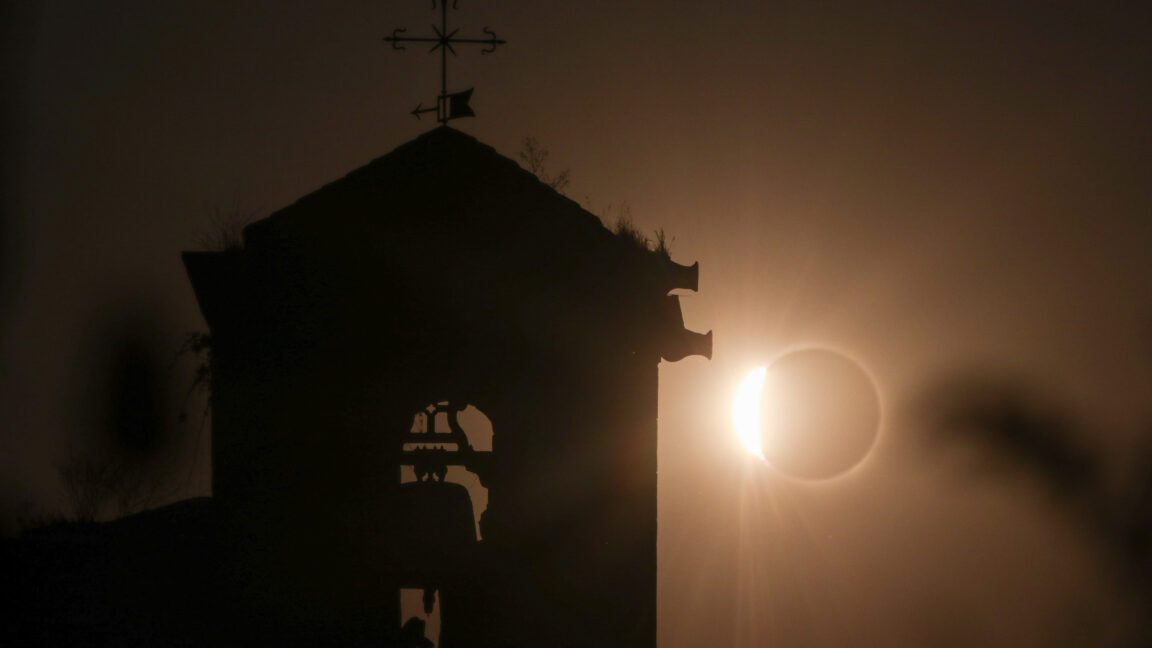
Here’s what it was like watching a total solar eclipse 90 minutes north of Madrid.
DURATÓN, Spain—I’ll say it: I’m hooked. Standing in the shadow of the Moon is one of the rarest opportunities to directly sense the mechanics of our Solar System, when the dance between three celestial bodies slides into perfect alignment. It’s a mathematical miracle whose rarity and grandeur are made possible by the relative sizes and distances of the Moon and the Sun from Earth. Not every planet is so lucky.
The Moon’s shadow crisscrossed the American heartland twice in less than seven years, first in 2017 and again in 2024. I was fortunate to witness both. The experiences left me too impatient to wait for the next total solar eclipse in the continental United States in far-off 2044.
That’s what pulled me to the plains of north-central Spain last week. This land of wide open spaces, ancient churches and castles, and vast sunflower fields, all baking under the blinding August Sun, seemed like the perfect location to enter the path of totality. The ongoing drought in Spain has turned the country’s fields and forests into a tinderbox, but those conditions made for ideal eclipse viewing.
I’m an eclipse neophyte. This was only my third, far short of the world record (35) held by American umbraphiles Glenn Schneider and John Beattie. I crossed paths with far more seasoned eclipse chasers in Spain, one boasting as many as 20 trips into totality.
Anyone planning a trip to see a total solar eclipse needs to keep several things in mind. Have a backup plan. Ideally, you should have several backup plans. Cloud cover will ruin an eclipse, so if you’re set on seeing it, you need to be mobile on the big day. You should also plan for crowds and traffic and allow plenty of time to reach your viewing location. And, of course, be sure to take a pair of safe eclipse-viewing glasses.
It is also worth scouting for the eclipse ahead of time. A friend and I settled on a rural location in Duratón, Spain, about 60 miles (100 kilometers) north of Madrid. Watching from there would give us a little more than 1.5 minutes of totality with a bucolic landscape anchored by a Romanesque church dating to the 12th or 13th century. We traveled there exactly 24 hours before the eclipse to get an idea of what to expect.
The old Catholic church in Duratón had ample parking and was far enough from sizable towns to escape the largest crowds. But we weren’t alone as eclipse time neared last Wednesday. One hundred or more local residents, tourists, and photographers descended on the church grounds with cameras, telescopes, music, and their favorite libations.
The setting was, at the same time, ancient and modern, natural and human. The church was built next to a Visigothic cemetery with anthropomorphic rock-cut tombs. Up the hill, about 1,000 feet away, lay the ruins of the Roman city of Confloenta undergoing archaeological study. For a few moments, I thought of how those civilizations in this very spot might have reacted to the splendor—no, terror!—of the Sun suddenly going dark.
By then, it was showtime. Through eclipse glasses, we could see the Moon taking an ever-larger bite from the Sun until, finally, less than an hour before sunset, the lights went out. The church bells rang. The crowds cheered. The Sun’s turbulent outer atmosphere appeared as a ghostly white halo over Duratón’s centuries-old place of worship.