// KOTAKU — GAMING
The Creators Of Big Walk Break Down The GOTY Contender’s Development, Puzzles, And Stunning Ending
After over a decade of remote work in a very remote industry covering an equally remote industry, I’m a little exhausted by Zoom interviews. The vast, vast majority of my conversations with developers take place in little video boxes, often with poor-quality webcams and audio and everyone feeling a bit disconnected and unusual. That doesn’t mean all or even most of my interviews are bad ones (I hope!), but there’s certainly something far more exciting, tangible, and emotional about getting to do one in person. It’s often easier to connect with the other person, and I feel like I get better answers.
But even those can be a bit stilted, perhaps just because of the inherent oddness of sitting down with someone for a period of time and grilling them with questions. It’s often led me to wish there were better, more comfortable ways to speak to people, especially in situations where I’m not grilling a CEO on their latest terrible practice, but rather chatting amicably with an artist who’s made something I deeply, deeply love.
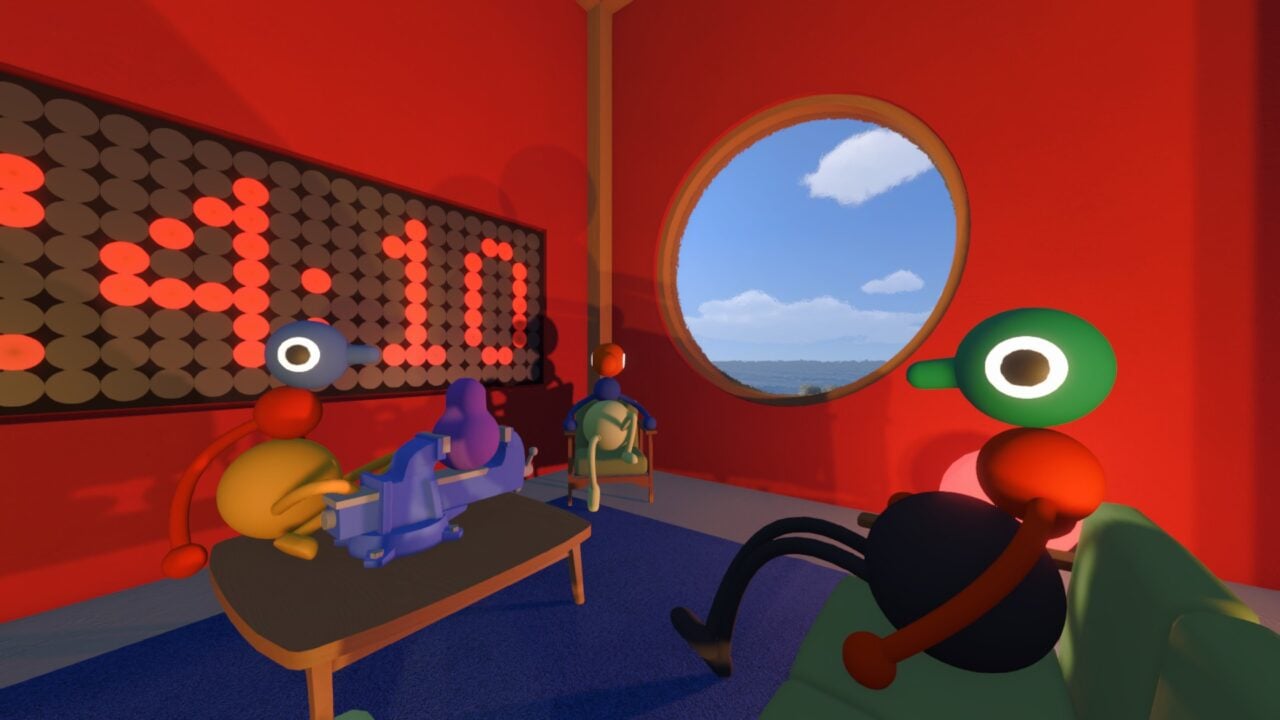
I am so happy that the developers of Big Walk not only agreed to my invitation to be interviewed within Big Walk, but that it went as well as (if not better than) I could have hoped. I went on a nearly 90-minute stroll with Stuart Gillespie-Cook, Jake Strasser, and Nico Disseldorp, three of the five full-time members of House House. For a lot of the walk, we weren’t doing anything more complex than sitting somewhere and waving our little characters’ arms around. But there was just something delightful about the environment, the silliness of it all, and just existing within their creation that broke through the stiffness I often feel in Zoom interviews.
Maybe it was the effect of the interview space, or perhaps it’s just that Gillespie-Cook, Strasser, and Disseldorp are entertaining people and artists who gave great, thorough answers to all my questions. But whatever the case, I didn’t want to split this interview up into a bunch of smaller stories, or summarize or truncate it in any way. I think the whole conversation was worth printing, so here it is. Responses have been lightly edited for length and clarity. One question and its answers, regarding the “log out” noise, was moved from its actual location in the interview at the very, very end to a spot where it flowed a bit better for readers, but otherwise the pacing is untouched.
All three of them told me their official title was just “developer,” but did give me a bit more preliminary info on what their roles were.
Stuart Gillespie-Cook does “capital G Game Design,” “looked at the animation,” and lately has done a lot of QA. He’s depicted as (from top to bottom) red, blue, and yellow in the attached screenshots.
Jake Strasser is “responsible for the world” alongside (not present) Kalonica Quigley, who is House House’s first new employee, hired when the studio grew from four to five between its previous release, Untitled Goose Game, and the new Big Walk. Strasser says he “put all the rocks everywhere,” did a lot of technical art, and “probably made it really hard to walk for you.” He’s in the screenshots as the green, red, and brown character.
Finally, Nico Disseldorp is a programmer and designer, and made a bunch of Big Walk’s challenges along with Gillespie-Cook. He’s blue, red, and gold in the images.
The final member of House House, not present, is Michael McMaster, who was in charge of “aesthetics.”
One last note: this interview covers every aspect of the game, including the ending. Major spoilers are ahead, so please proceed with caution.