// NATURE NEWS — SPAZIO & SCIENZA
A global atmospheric methane record from a tropical ice core
Nature
(2026) Cite this article
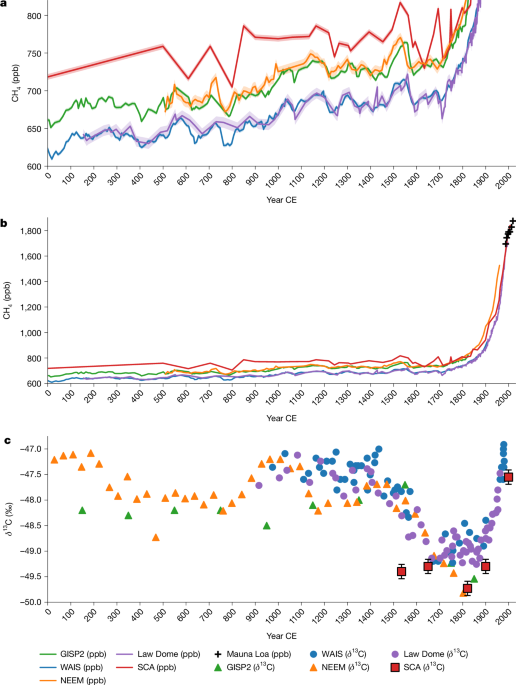
Tropical wetlands are widely considered the largest natural source of atmospheric methane (CH4)1,2,3,4. However, uncertainties about wetland extent and CH4 production have led to large variations in modelled CH4 emission trends2,3. Most historical reconstructions rely on data from polar ice cores, which cannot fully resolve the tropical contribution5,6 to the CH4 budget. Here we present a 2,000-year record of atmospheric CH4 concentrations from ice cores drilled from the South Peak summit of Nevado Huascarán (Summit Core A, SCA; −9.122° S, −77.605° W; 6,768 m asl). We find that the trends and magnitudes of our CH4 record are broadly consistent with polar records7. Our δ13C-CH4 measurements (from approximately 1530 CE to 1999 CE) align with isotope values8 consistent with a dominant tropical CH4 source. Integration of our record into an atmospheric four-box model suggests a sustained equatorial dominance of CH4 source strength over the past two millennia. Our findings indicate that equatorial CH4 emissions are higher than previous estimates based only on polar ice core data, supporting the long-standing hypothesis that low-latitude CH4 emissions dominated pre-industrial (PI) CH4 variability5,6. These results demonstrate the importance of tropical ice cores on the reconstruction of CH4 variability and latitudinal distribution.
Atmospheric CH4 concentrations varied between approximately 350 and 800 parts per billion (ppb) over the past 800,000 years but since 1750 CE have risen approximately 160%, reaching 1,935 ppb in 20259. Estimations of past fluxes and emissions still contain uncertainty, highlighting the need for improved constraints on the role of the tropics in CH4 production5,10,11,12,13,14,15. To better understand past changes in global levels of CH4, the inter-polar difference (IPD) was reconstructed from the Greenland Ice Sheet Project 2 (GISP2; Greenland) and West Antarctic Ice Sheet (WAIS; Antarctica) cores7. From 800 to 1750 CE, the IPD is on average 44 ± 7 ppb, with GISP2 above the WAIS record7. This is interpreted as a reflection of the long-term dominance of Northern Hemisphere emissions. However, these polar-derived mixing ratios only indirectly reflect concentrations in the tropics, creating uncertainty as to the role of tropical sources in historical CH4 variability5,6.
Consistent, long-term CH4 records from low-latitude ice cores would greatly improve our understanding of the atmospheric CH4 history, but the few existing records are affected by notable complications. For example, a core from the Sajama ice cap in Bolivia (18° S) records large (100–900 ppb) spikes in CH4 concentrations that are probably linked to elevated dust levels16, which is an issue also documented at smaller magnitudes17 in Greenland cores. Methane records from the Himalayan Dasuopu glacier (28° N) show an average concentration roughly 120 ppb higher than average Greenland levels; however, frequent melt layers are thought to impose unrealistically large variability as well as high uncertainty (±37 ppb) on the CH4 record18. The Mount Everest East Rongbuk Glacier ice core (28° N)19 shows late PI Holocene CH4 that are about 36 ± 17 ppb higher than in Greenland cores, but only 15 of the original 112 values are considered valid after outlier elimination.
In 2019, the Byrd Polar and Climate Research Center (BPCRC) ice core research team conducted an ice core drilling programme on Nevado Huascarán (−9.122° S, −77.605° W), the world’s highest tropical mountain located in the Cordillera Blanca in the Peruvian Andes (Extended Data Fig. 1). Two cores were drilled to bedrock on the summit of the South Peak (6,768 m asl). Methane measurements were made on discrete samples from SCA, yielding the first such CH4 concentration record from the tropics.
The most recent 2,000 years of the SCA CH4 data are compared with CH4 data from the GISP2 and WAIS Divide cores7 to evaluate the latitudinal