// NATURE NEWS — SPAZIO & SCIENZA
Atomic-scale double-slit interferometry with a focused electron probe
Nature
(2026) Cite this article
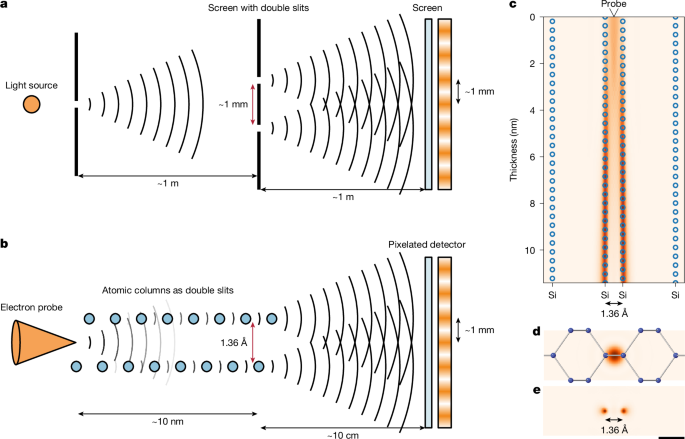
Since Young’s original work with light1, double-slit interference experiments have been paradigmatic demonstrations of wave–particle duality2,3,4,5,6. They now underpin modern electron, neutron, atom and molecule interferometers, whose fringe visibility and phase encode quantitative information about both the wave and the diffracting object. Extending this to atomic length scales would offer direct, local access to microscopic structure and dynamics, but has remained unexplored. Here we show that double-slit interferometry can be realized at atomic scales inside a crystal. Using scanning transmission electron microscopy (STEM), we demonstrate the generation of interference fringes with a focused electron beam that is delocalized over two adjacent Si [110] atomic columns separated by 1.36 Å. At finite temperature, these two atomic ‘slits’ vibrate strongly, imprinting their motion on the fringes. The fringes persist from 300 K to 900 K, indicating that only a subset of phonon modes degrades visibility; correlated thermal vibrations between neighbouring atoms preserve coherence that independent motion would otherwise destroy. Quantitative analysis of this preserved visibility provides direct experimental access to vibrational correlations between a pair of atomic columns. These correlations map to the anisotropic stiffness of the specific atomic bond, giving access to the low-energy phonon dynamics that affect thermal transport. By recasting crystals as atomic-scale interferometers, this platform enables direct visualization of local atomic arrangements and their correlated dynamics, opening routes to examine lattice dynamics at the single-bond level.
Since Thomas Young’s original demonstration with light in the early 1800s1, double-slit experiments have evolved far beyond a proof of wave–particle duality into a precision framework for extracting quantitative information from interference fringe visibility and phase. Over the past century, this model has extended from photons to matter waves, progressing to increasingly massive particles—electrons2, neutrons3, atoms4 and even complex molecules5,6—underpinning a diverse array of transformative measurement platforms. Today, electron holography7,8, atom interferometry9,10 and gravitational-wave observatories11 exemplify how fringe visibility and phase serve as precision readouts for electromagnetic fields, inertial forces and spacetime curvature, respectively. Pushing interferometry towards atomic scales, recent experiments have used crystal lattices12 and diatomic molecules13,14 as effective slits. The unifying power of interferometry lies in its ability to encode physical quantities into interference patterns; shrinking the interferometer to atomic dimensions thus offers the prospect of investigating matter at the single-bond level. This atomic confinement is expected to bring intrinsic spatial localization, potentially granting access to symmetry-broken regions such as defects and interfaces.
Crystalline solids present an ideal architecture for this goal: atoms locked at lattice sites could act as double slits with well-defined separations, offering direct access to local structure and dynamics. However, extracting such local information from real crystals requires circumventing the spatial averaging inherent to the periodic lattice by strictly confining the interaction to a focused atomic-scale volume. This challenge is addressed by recent advances in STEM15. Aberration-corrected electron probes allow for the targeting of individual atomic pairs, whereas segmented and pixelated electron detectors capture detailed convergent-beam electron diffraction (CBED) patterns at each probe position (for example, differential phase contrast STEM16,17, optimum bright-field STEM18 and four-dimensional STEM (4D-STEM)19) with sufficient sensitivity and speed. Here we demonstrate that crystalline materials can function as true atomi