// NATURE NEWS — SPAZIO & SCIENZA
Human brain organoids record the passage of time over multiple years
Nature
(2026) Cite this article
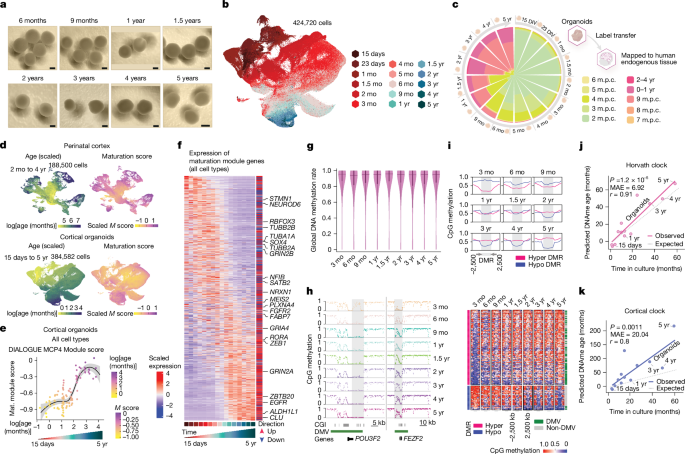
The human brain develops and matures over an exceptionally prolonged period of time that spans nearly two decades of life. Processes that govern species-specific aspects of human postnatal brain development are difficult to study in animal models1. While human brain organoids offer a promising in vitro model, they have thus far been shown to largely mimic early stages of brain development. Here we develop human brain organoids for 5 years in culture, optimizing growth conditions to extend excitatory neuron viability beyond previous limits. Using maturation-associated modules derived from endogenous human brain, we show that brain organoids transcriptionally age with cell type specificity over years in culture. Whole-genome methylation profiling reveals that the predicted epigenomic age of organoids correlates precisely with time spent in vitro, and parallels epigenomic ageing in vivo. Notably, we show that in chimeric organoids generated by mixing neural progenitors of different ages, old progenitors rapidly produce late neuronal fates, skipping the production of earlier neuronal progeny, therefore showing that progenitors that age in organoids retain a memory of the time spent in vitro. The data indicate that human brain organoids can continue to mature and record the passage of time over many years in culture.
Human brain development is orchestrated by transcriptional programs defined by spatially and temporally regulated waves of gene expression. These gene expression patterns are tightly coordinated by dynamic changes in the activity of regulatory elements and epigenomic remodelling, ensuring the timely emergence of distinct neural cell types and the progressive maturation of the nervous system. In humans, brain development and maturation proceed at a much slower pace than in most other species, with cortical neurons requiring years to reach full maturity. This protracted timeline is preserved in all cell types generated in vitro from human pluripotent stem (hPS) cells, including cortical neurons, pointing at a cell-intrinsic clock that sets the pace of brain development, although its molecular mechanisms and functional significance remain to be elucidated1,2. Recent work has shown the importance of epigenetic barriers that enforce the slow timing of human neuronal maturation1, and the role of species-specific rates of mitochondrial metabolism in influencing developmental tempo3. Human organoids could, in principle, be used to study these processes of human brain maturation, but existing models largely recapitulate earlier developmental processes, and most studies do not follow organoids over a sufficiently long time span. One report cultured organoids for up to 694 days, and used bulk RNA-sequencing (RNA-seq) and methylation arrays to profile whole organoids4. However, there is known variation in the ability of distinct cell types to survive over long periods in culture, especially neuronal populations. Moreover, beyond the continued presence of a cell type, there is a need to understand whether structural and functional properties such as neuronal architecture and coordinated circuit activity are present over years in culture. It is therefore important to resolve and analyse individual cell populations and their functional features across different modalities along these extended timelines. Without cell-type-specific knowledge, and in the absence of longer timelines of maturation, we currently lack understanding of the mechanisms by which the many individual cell types of the human brain mature in vitro, and whether they can measure and record time as they do in vivo.
Here we developed human cortical organoids for over 5 years in culture and integrated single-cell transcriptional information with epigenetic, structural and functional data to build a comprehensive map of development and maturation across an unprecedented time span. The data indicate that huma