// NATURE NEWS — SPAZIO & SCIENZA
Computational ‘gym’ trains AI models to control turbulence
Clara M. Velte is in the Department of Civil and Mechanical Engineering, Technical University of Denmark, Kongens Lyngby 2800, Denmark.
Search author on:
PubMed
Google Scholar
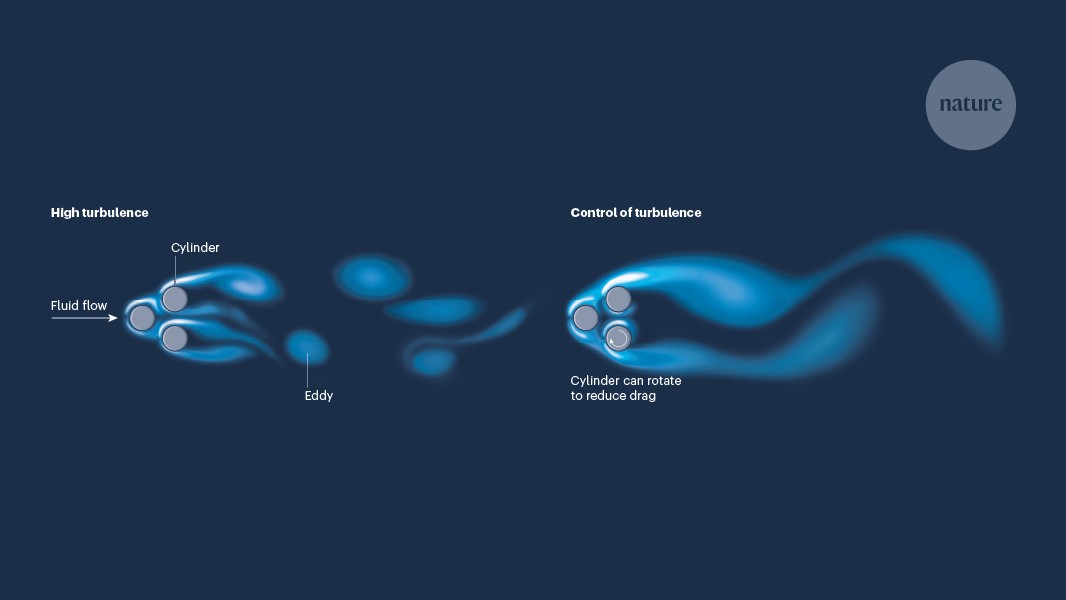
Turbulent fluid flow is a persistent challenge in physics and engineering: it disrupts aviation and reduces the efficiency of wind turbines. In the body, disturbed blood flow can even contribute to problems in the circulatory system. Turbulence is also complex and unpredictable, so devising strategies to control it is notoriously difficult. Now, writing in Nature, Lagemann et al.1 report the development of HydroGym, a platform for training artificial-intelligence models that learn, through trial and error, to control fluid flows. The authors show that control strategies learnt in one fluid-flow environment can be transferred, without further training, to a more complex one. If these control strategies can be verified experimentally, HydroGym could have implications well beyond fluid dynamics.
Access Nature and 54 other Nature Portfolio journals
Get Nature+, our best-value online-access subscription
Prices may be subject to local taxes which are calculated during checkout
Lagemann, C. et al. Nature https://doi.org/10.1038/s41586-026-10917-6 (2026).
James, S., Ma, Z., Arrojo, D. R. & Davison, A. J. IEEE Robotics Automation Lett. 5, 3019–3026 (2020).
Velte, C. M. Non-Equilibrium Turbulence: A Combined Empirical-Theoretical Approach To-ward Improved Understanding in the Post-Kolmogorovean Era. PhD thesis, Technical University of Denmark (2026).
Read the paper: The HydroGym reinforcement learning platform for fluid dynamics