// ARS TECHNICA — FINANZA
Amazon aims for delivery drones to reach 500 US neighborhoods by end of 2026
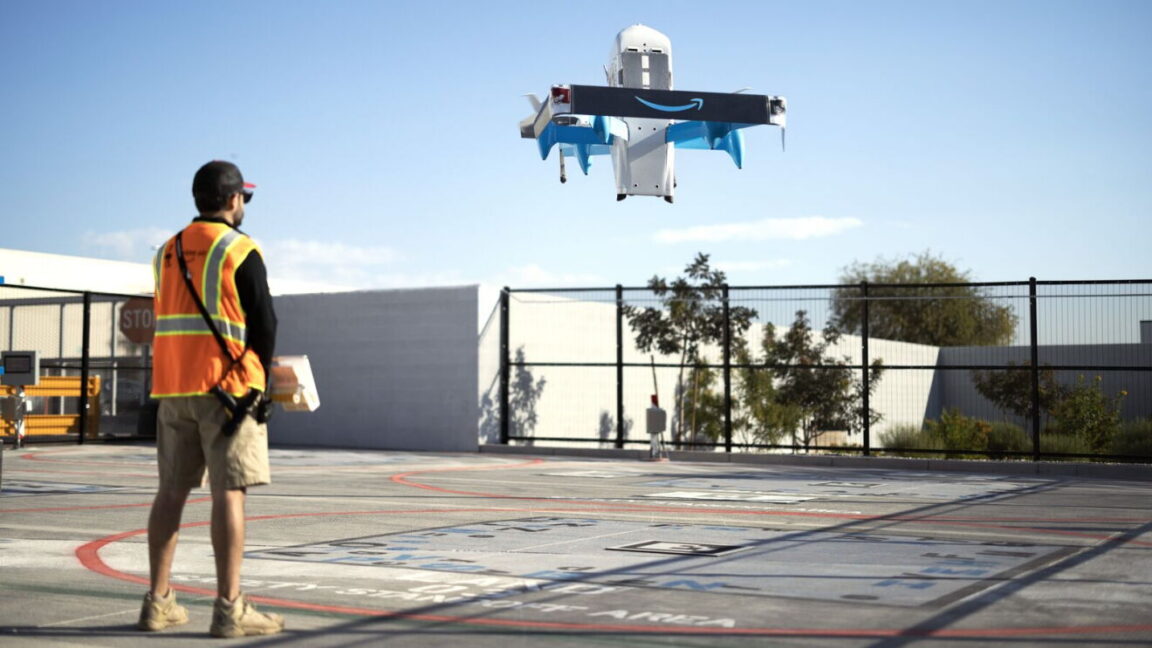
US residents face trade-offs as delivery drone services such as Prime Air expand.
Amazon wants to grow its Prime Air delivery drone service sixfold to reach nearly 500 cities and towns across the United States by the end of 2026. The planned expansions from Amazon and its rivals could make the convenience of delivery drone services available to tens of millions more people in the coming months—but will also test more communities’ tolerance for increased noise from daily drone flights.
On August 19, Amazon announced it would soon launch Prime Air in the metropolitan areas of Chicago; Cleveland; Atlanta; Syracuse, New York; and Boise, Idaho, with more to come later in the year. Each Prime Air site offers delivery drone service within an area of about 175 square miles, with delivery times ranging from half an hour to an hour.
Prime Air already operates out of Amazon warehouses in 10 cities across seven states. Those include primarily suburban neighborhoods of Phoenix; Tampa; Kansas City; Omaha, Nebraska; Baton Rouge, Louisiana; Detroit; Houston; and San Antonio, Dallas, and Waco, Texas.
The Amazon Prime Air expansion comes as competitor Walmart has teamed up with the companies Wing and Zipline to scale up its own delivery drone service. Walmart recently celebrated the milestone of surpassing 1 million drone deliveries after operating from 66 stores across four states, and is looking to expand that service footprint to more than 270 Walmart stores by 2027.
Separately, Zipline also just announced a partnership with Uber aimed at scaling up to 1 million drone deliveries per day by the end of 2029. Having initially pioneered long-range drone deliveries of blood and other crucial medical supplies in Africa, Zipline has been steadily growing its US delivery operations and claims to have already made more than 2.7 million deliveries worldwide.
Even DoorDash is looking to build its own in-house delivery drone program. In July, the delivery service company announced it had received its FAA Part 135 certification to launch what it describes as DoorDash Air—though it is still in the early phases of designing its delivery drone and planning out operations.
The accelerating US expansion of drone delivery services promises speedy deliveries to customers within an hour, and sometimes within minutes in the fastest cases. Such autonomous drones typically run on battery-electric power and potentially offer lower-emission, lower-cost operations without putting more vehicles on the road for last-mile deliveries.
However, delivery drones are still limited in how much they can carry. For example, Amazon describes its drones as being capable of handling nearly all items weighing five pounds or less that can fit within a large shoebox. Strong winds, heavy rain or snow, and extreme cold can also prevent drones from operating.
There have also been community concerns about safety, privacy and especially noise pollution in neighborhoods serviced by drones. None of those issues are likely to go away as US companies ramp up delivery drone services nationwide with the regulatory approval of the US Federal Aviation Administration.