// NATURE NEWS — SPAZIO & SCIENZA
Moderna cancer vaccine stops melanoma returning: what’s next for personalized treatments?
Rachel Fieldhouse is a reporter for Nature in Sydney, Australia.
Search author on:
PubMed
Google Scholar
Search author on:
PubMed
Google Scholar
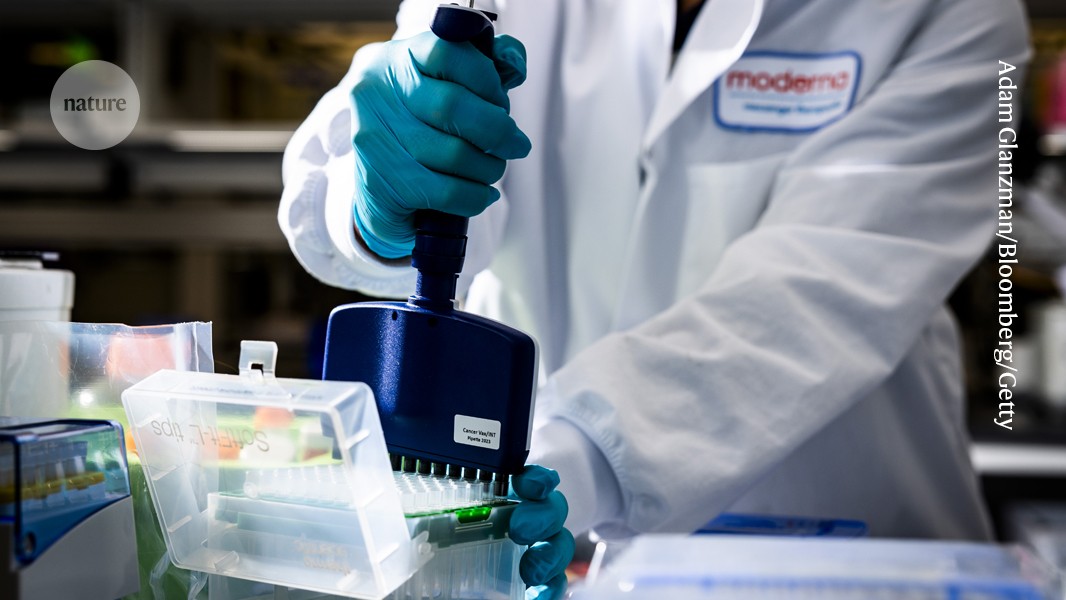
A cancer vaccine developed by Moderna and Merck reduced the recurrence of melanoma.Credit: Adam Glanzman/Bloomberg/Getty
A personalized mRNA vaccine for melanoma reduced the risk of the cancer returning in a phase III clinical trial, the companies behind the trial announced this week. The vaccine — which relies on the same mRNA technology used to develop COVID-19 shots — is the first mRNA-based cancer treatment to show success in a late-stage trial.
“It’s incredibly exciting,” says Seth Cheetham, an mRNA scientist at the University of Queensland in Brisbane, Australia. “This is the first really large-scale trial” to release data for a personalized mRNA cancer vaccine. The results put it a step closer to regulatory approval for wider use and could bolster the whole field, he adds. Marco Gerlinger, a medical oncologist at St Bartholomew’s Hospital in London, says the study provides proof of principle that personalized cancer vaccines work. “This is important as they can be designed against many different cancer types,” adds Gerlinger, who is a principal investigator on a trial for a cancer vaccine being developed by BioNTech in Mainz, Germany.
The study could have implications beyond the field of cancer, too, says Sam Barrell, the chief executive of medical research charity LifeArc, in London. It will help to build confidence in more-tailored approaches to treatments for rare conditions that are often driven by unique genetic mutations, she adds.
The vaccine, called intismeran, doesn’t prevent a person from developing cancer in the first place, rather it seeks to prevent it from recurring.
The study enrolled around 1,100 people with advanced melanoma that had been completely surgically removed. They received either the vaccine combined with an immunotherapy drug called pembrolizumab, which is used to treat the cancer, or they received pembrolizumab alone. The vaccine’s developers Merck, in Rahway, New Jersey, and Moderna, which is headquartered in Cambridge, Massachusetts, announced on Wednesday that people on the combined treatment survived for longer without recurrence than did those who received only pembrolizumab. The companies said that they plan to present more-detailed data at an upcoming medical conference.
To create intismeran, a sample of a person’s tumour is sequenced to identify mutations that have developed in their cancer cells. These mutations mean that a cancer cell expresses abnormal proteins called neoantigens, which act like flags on its surface that the immune system attacks. An mRNA vaccine is developed according to each person’s cancer neoantigens, and once injected, it instructs the body to make the neoantigens — priming the body to recognize the threat. “We had never been able to train an individual patient’s immune system against their own tumour before,” says Adnan Khattak, a medical oncologist and an investigator in the trial at Hollywood Private Hospital in Nedlands, Australia.