// SPACE.COM — SPAZIO & SCIENZA
SpaceX launching its 1st 'Starfall' reentry capsule early on June 23: Watch it live
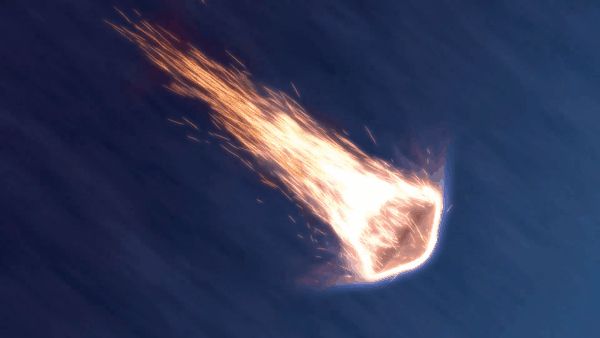
This will be the first of at least two Starfall demos.
When you purchase through links on our site, we may earn an affiliate commission. Here’s how it works.
SpaceX's newest spaceflight tech is about to launch to the final frontier for the first time.
The company's Starfall capsule is set for its debut mission, following SpaceX's application with the U.S. Federal Aviation Administration (FAA) for two reentry vehicle landings. The mission is scheduled to lift off from Space Launch Complex-40 at Cape Canaveral Space Force Station in Florida on Tuesday (June 23), during a one-hour launch window that opens at 6:43 a.m. EDT (1043 GMT).
You can watch the action live via SpaceX, which will stream it live starting about 10 minutes before liftoff.
Starfall is a cargo transportation vehicle designed to carry payloads to low Earth orbit (LEO) and beyond, aboard SpaceX's Falcon 9 and Falcon Heavy rockets, and also return materials safely back to Earth. The platform isn't designed to fly human passengers; it's geared toward the support of research or other payloads that require retrieval after a stint in space, such as pharmaceuticals and other products of orbital manufacturing.
The concept has already been put into practice by Varda Space, which has landed five of its 3-foot-wide (0.9 meters), roughly 650-pound (300 kilograms) conical "W-series" capsules to date, one of which returned a payload for the U.S. Air Force after more than eight weeks on orbit. Starfall is more than three times as large, measuring 10 feet (3.1 m) across and 2.5 feet (0.75 m) tall. The SpaceX vehicle can carry up to 2,200 pounds (1,000 kg) of payload.
Starfall has two primary sections, which separate after reentry: a top plate for payload storage and attitude control components, and a carbon fiber heat shield that stores compressed gas to power attitude control maneuvers needed for precise reentries and landings, heat shield jettison and parachute deployment, according to SpaceX's FAA filing.
SpaceX plans to launch Starfall on suborbital missions, in addition to the longer-term stretches it will be able to spend in LEO. The capsule lacks a propulsion system and is incapable of deorbiting itself. The FAA document is unclear about how this will be accomplished, but it's likely that this launch will use Falcon 9's second stage to bring the demo capsule back to Earth.
In the event that Starfall experiences some sort of issue in space or during reentry, SpaceX has designed the spacecraft for safe expendability. "Capsules use nonhazardous inert cold gas (nitrogen) for attitude control and contain no liquid propellants or hazardous substances. All pressurized systems would be vented prior to splashdown, therefore, no propellants would be released into the ocean," the company says in the FAA document.