// SPACE.COM — SPAZIO & SCIENZA
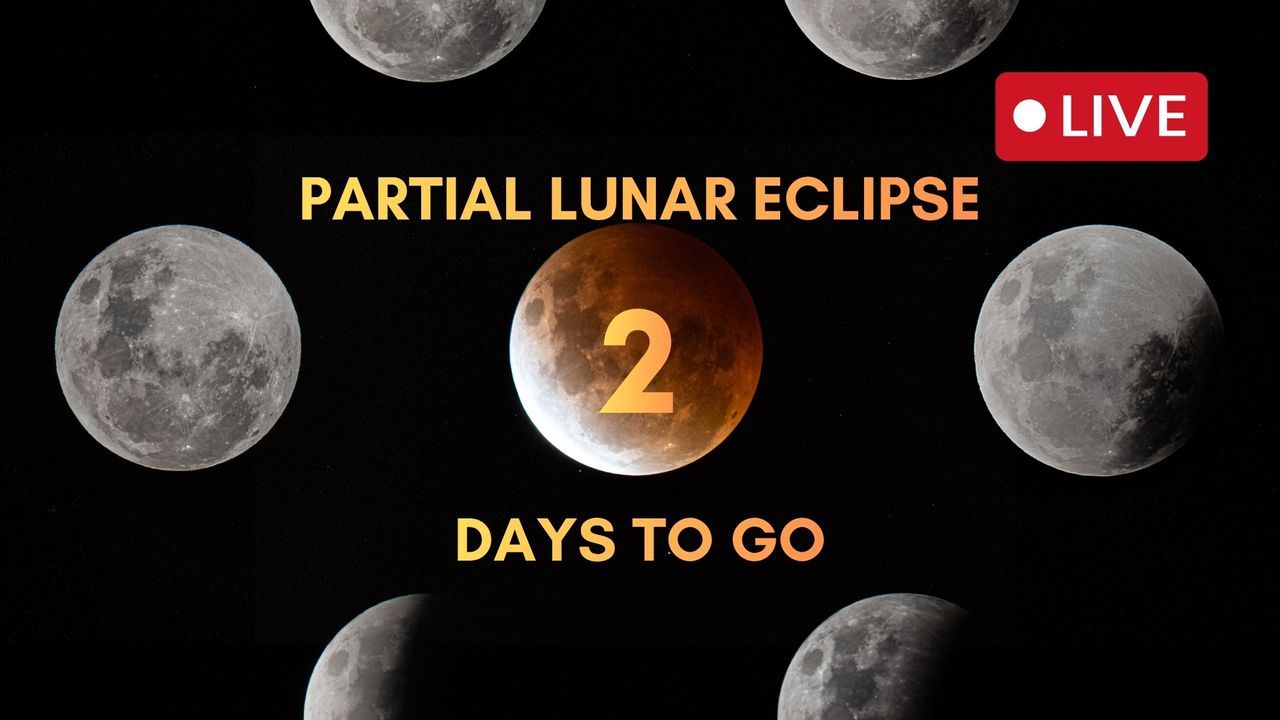
Partial lunar eclipse Aug. 27-28 live updates: 2 days to go, what time is the eclipse?
When you purchase through links on our site, we may earn an affiliate commission. Here’s how it works.
The countdown is on for the deep partial lunar eclipse of Aug. 27-28. Over the next week, we'll be bringing you the latest eclipse news, viewing tips as well as live updates throughout eclipse night.
Although this isn't quite a total lunar eclipse, it's pretty close! At maximum eclipse, 96.2% of the moon will slip into Earth's dark central shadow known as the umbra, according to Time and Date. Much of the moon may take on a rusty red hue, while a thin sliver remains brightly illuminated.
It's the deepest partial lunar eclipse visible anywhere on Earth until Dec. 31, 2028, making it a must-see event worth staying up late — or setting an alarm early — for.
Planning to watch the deep partial lunar eclipse this week? You'll want to make sure you're looking up at the right time.
The eclipse begins at 9:23 p.m. EDT on Aug. 27 (0123 GMT on Aug. 28), when the moon enters Earth's faint outer shadow, known as the penumbra. From then, the eclipse will deepen and become more visible over several hours as the moon passes into Earth's darker umbral shadow, ultimately leaving 96.2% of the lunar surface covered at its peak.
For key timings and when exactly to look up, check out our guide on when the partial lunar eclipse will occur.
A partial lunar eclipse has five distinct phases that occur simultaneously for everyone on the night side of Earth as our planet slips between the sun and its natural satellite during the full moon phase.The eclipse begins as Earth's outer penumbral shadow subtly darkens the moon, after which the inner umbral shadow reveals our planet's curved silhouette as it advances across the lunar disk.Read more: What to expect from each stage of the partial lunar eclipse on Aug. 27-28
The deep partial lunar eclipse is just a few days away, so now is the perfect time to start planning how you're going to view the "almost blood moon".
At maximum eclipse, 96.2% of the moon's surface will be covered by Earth's dark central shadow known as the umbra. While the moon won't be completely eclipsed — so this isn't technically a "blood moon" — much of the lunar surface is expected to take on a reddish-orange hue, with just a thin sliver remaining brightly illuminated.