// NATURE NEWS — SPAZIO & SCIENZA
The brain struggles to make new neurons in people with depression
Mariana Lenharo is a reporter for Nature in New York City.
Search author on:
PubMed
Google Scholar
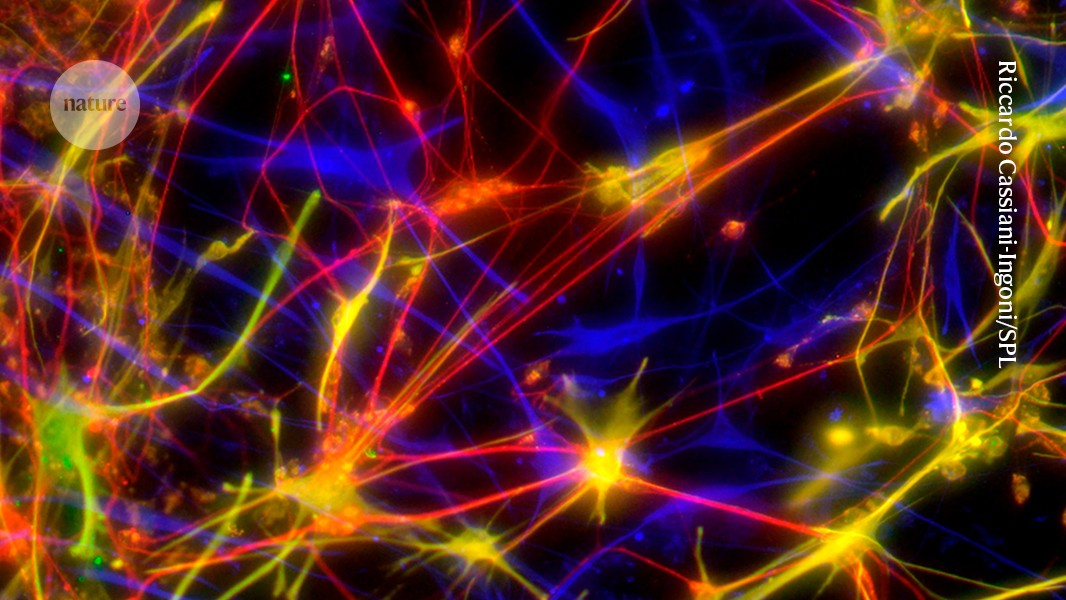
The formation of neurons in the brain (shown here) was found to be impaired in people with depression. Credit: Riccardo Cassiani-Ingoni/SPL
The brains of people with depression seem to be worse at producing new neurons than are those of people without the disorder. That’s according to a study1 that includes the most comprehensive map of the cell types in the human adult hippocampus, a brain region involved in learning, memory and emotions.
For more than 20 years, some researchers have suspected2 that a disruption in neurogenesis — the process of making new neurons — could be involved in depression. “This paper, excitingly, is the first to show at single-cell resolution exactly where in the process things appear to be awry and what molecular machinery is involved,” says Amelia Eisch, a neuroscientist at the University of Pennsylvania in Philadelphia, who was not involved with the research.
A journey into the causes and effects of depression
The study, which was published last week in Nature Medicine, doesn’t establish that impaired neurogenesis plays a part in causing depression, and researchers are careful to note that depression involves multiple brain areas, not just the hippocampus. Still, the findings could point to new therapeutic targets. “We found several potentially druggable pathways involved in the pathogenesis,” says Maura Boldrini Dupont, a neuroscientist at Columbia University in New York City and one of the authors of the paper.
The work also provides further evidence to support the idea that the human brain continues to produce new neurons into adulthood. The existence of adult neurogenesis has been the topic of a long-standing debate, because some studies3 have failed to detect it.
And it goes a step further, suggesting that these freshly generated neurons not only exist but also have a distinct function, says Gerd Kempermann, a neuroscientist at the German Center for Neurodegenerative Diseases, in Dresden. These results are "really strong and interesting,” he says.
The authors analysed brain tissue collected from 30 people shortly after their deaths. Eleven of the donors had major depressive disorder (MDD), also called clinical depression; 19 didn’t have mental-health conditions and served as a control group. Researchers sequenced RNA in the nuclei of almost 500,000 cells from these individuals’ hippocampi. The single-nucleus RNA sequencing provided a snapshot of gene activity in each cell. Scientists know which genes are associated with various stages of neuronal development, so gene activity serves as a molecular marker of cell maturity.