// NATURE NEWS — SPAZIO & SCIENZA
Tidal tomography reveals a thermal anomaly beneath Mars’s crustal dichotomy
Nature
volume 656, pages 848–853 (2026) Cite this article
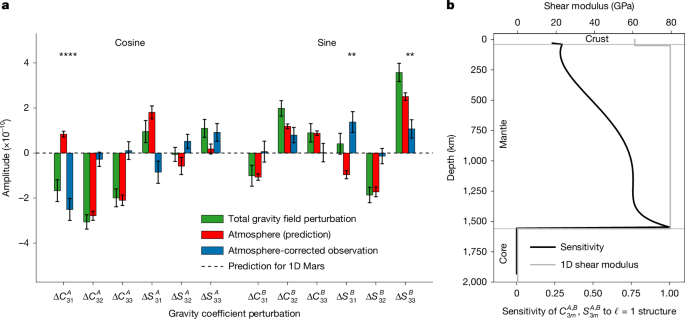
Mars undergoes seasonal tidal forcing as a result of its eccentric orbit and the tilt of its rotation axis relative to the Sun1. Response to this forcing produces temporal variations in the Martian gravity field and is sensitive to the internal structure of the planet2,3,4. Using tracking data from the Mars Global Surveyor (MGS), Mars Odyssey (ODY) and Mars Reconnaissance Orbiter (MRO) spacecraft5,6,7, we demonstrate that degree-3 components of the time-variable gravity field of Mars differ by up to 300% from predictions for a spherically symmetric planet8,9,10. These deviations can be explained if the effective shear modulus of the mantle varies by >20% over a roughly north–south pattern that closely aligns with the surface expression of the Martian crustal dichotomy11. On the basis of this correlation, we infer preservation of a 200–400 °C thermal anomaly in the present-day mantle below the southern highlands of Mars. This temperature variation could reflect regional mantle convection12,13 or insulation by the thick southern highlands crust of Mars that has persisted over several billion years14,15.
Mars exhibits a prominent dichotomy in crustal structure. Whereas low-lying plains cover the northern hemisphere of Mars, the southern hemisphere is more topographically elevated, rugged and densely cratered16. These asymmetries potentially accompany an approximately 25 km mean variation in crustal thickness11 (or a roughly 200 kg m−3 variation in crustal density17,18), as well as spatial differences in crustal magnetization19 and seismic wave attenuation20. The northern lowlands may also have held surface water before the loss of Mars’s putative oceans to space21. Understanding the origin of the crustal dichotomy of Mars therefore constrains the planet’s ancient hydrology and the timing of surface conditions capable of supporting life22.
The origin of the hemispheric crustal dichotomy of Mars is widely debated. Some studies suggest that a giant impact disrupted the primordial mantle of the planet and either thickened the crust across the southern hemisphere23,24 or excavated the northern hemisphere25. Other studies suggest that mantle convection over one hemisphere drives subsidence and resurfacing of the northern crust or thickening and uplift of the southern crust12,13. These formation hypotheses for the crustal dichotomy predict long-lived structures within the Martian deep interior that may persist into the present day12,13,23,24. For example, crustal thickening over the southern hemisphere could enhance thermal insulation and radiogenic heating of the deeper interior, resulting in a structurally weak underlying mantle14,15. Here we investigate the character of these potential heterogeneities at depth by analysing the gravitational response of Mars to seasonal (that is, 687 Earth days) tidal interactions with the Sun.
The Martian gravity field can be expressed in terms of spherical harmonic coefficients of degree ℓ and order m (Cℓm and Sℓm), with the full wavelength at a given ℓ usually defined as roughly 2πR/ℓ (R = 3,396 km)26. Temporal variations can be modelled as cyclic perturbations to these coefficients and separated into in-phase (or ‘cosine’, A) and (a quarter cycle) out-of-phase (or ‘sine’, B) components over a given period (that is, \(\Delta {C}_{{\ell }m}^{A,B}\) and \(\Delta {S}_{{\ell }m}^{A,B}\)) (Methods). For a spherically symmetric planet, forcing at a given degree and order excites deformation only at the same degree and order. In this case, tidal forcing acts almost entirely at degree-2 and will contribute negligibly to the gravity field of Mars at higher degrees (that is, \(\Delta {C}_{3m}^{A,B},\Delta {S}_{3m}^{A,B}\approx 0\)). However, lateral heterogeneity in the internal structure of Mars (for example, north–south variations in shear modulus) can couple with degree-2 forcing to produce substantial degree-3 signa