// NATURE NEWS — SPAZIO & SCIENZA
Long-read sequencing reveals pre-meiotic gene conversion in sperm
Nature
(2026) Cite this article
Meiotic recombination is a fundamental process that generates genetic diversity by creating new combinations of existing alleles1. Whereas crossovers in humans are well characterized2, the more frequent non-crossovers that lead to gene conversion remain challenging to study. Here we show that single high-fidelity long sequencing reads from sperm can capture both crossovers and non-crossovers, which enables effectively arbitrary sample sizes for analysis from a single male. We analysed 2,382 candidate non-crossovers in 15 sperm samples from 13 donors, and identified a consistent component with properties distinct from PRDM9-induced recombination. This phenomenon was not associated with meiotic double-strand break sites identified by DMC1 binding, the crossover recombination map or GC-biased gene conversion, but was associated with genomic fragile sites. This component is also seen in paternal non-crossover gene conversions in pedigree data3. Applying the same analysis to 12 blood samples4, we observed non-crossover gene conversions with similar properties, but very few crossover events. Further, we demonstrate variation between donors for the different types of recombination, even when they share the same PRDM9 genotype. We suggest that a substantial fraction of the non-crossover gene conversion events seen in sperm arise prior to meiosis.
In meiotic recombination, repair of programmed double-strand breaks (DSBs) causes exchange of genetic material between homologous chromosomes. The accurate execution of this process is essential for maintaining genome integrity and for fertility in many organisms1. In humans and many other vertebrates, meiotic DSB generation is localized by sequence-specific binding of the zinc-finger PRDM9 protein5. A minority of these DSBs resolve into crossovers (COs), resulting in reciprocal exchange of alleles beyond the recombination site, and many more DSBs resolve as non-crossovers (NCOs), accompanied by a unidirectional transfer of genetic information over short intervals (gene conversion). Additionally, complex recombination events, in which multiple haplotype switches cluster in close proximity (up to a few kilobases), have been observed, in much smaller numbers than simple COs and NCOs2,6,7.
It is generally believed that germline NCOs, similar to COs, result from meiotic SPO11-induced DSBs1, but the fine-scale map of NCOs is known to be different from that of COs8, and we know that gene conversion also occurs in somatic tissues9. Indeed, recombination is an essential component of DSB repair in non-meiotic cells, which enables use of homologous sequence as a template during repair10. Most of our knowledge about meiotic recombination comes from pedigree3,6,7,11,12,13 and population-based statistical14,15,16,17,18,19,20 approaches, but these yield limited events per individual or rely on simplifying assumptions about demography, mutation rate and selective neutrality. More directly, it is possible to sequence many sperm cells from a single individual, each of which represents an independent meiosis. Early sperm sequencing assays targeted recombination hotspots by PCR and were limited to a few loci, while newer single-cell methods allow genome-wide insights into COs but lack resolution for NCOs8,21. Recently, long-read sperm sequencing spanning multiple heterozygous markers has enabled direct visualization of CO events22,23,24,25, but confident detection of NCOs requires very high accuracy to avoid confounding with sequence errors. One recent study of recombination events using long-read sequencing data from sperm and testis in human and six primates has examined NCO positional properties and tract lengths across species26.
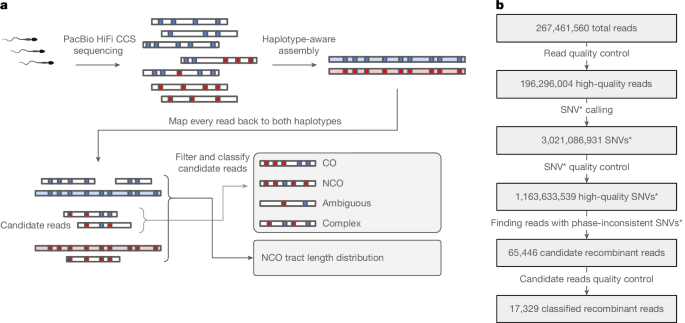
Here we use accurate long-read PacBio CCS sequencing of bulk sperm from 13 donors to identify both COs and NCOs genome-wide, revealing a substantial pre-meiotic NCO component that is shared with somatic tissue, indivi