// NATURE NEWS — SPAZIO & SCIENZA
Vaporization trick enables ‘tandem’ solar cells to be made at lower temperatures
Ulrich W. Paetzold is at the Institute of Microstructure Technology, Karlsruhe Institute of Technology, 76344 Eggenstein-Leopoldshafen, Germany, and at the Light Technology Institute, Karlsruhe Institute of Technology, Karlsruhe, Germany.
Search author on:
PubMed
Google Scholar
Paul Fassl is at the Institute of Microstructure Technology, Karlsruhe Institute of Technology, 76344 Eggenstein-Leopoldshafen, Germany, and at the Light Technology Institute, Karlsruhe Institute of Technology, Karlsruhe, Germany.
Search author on:
PubMed
Google Scholar
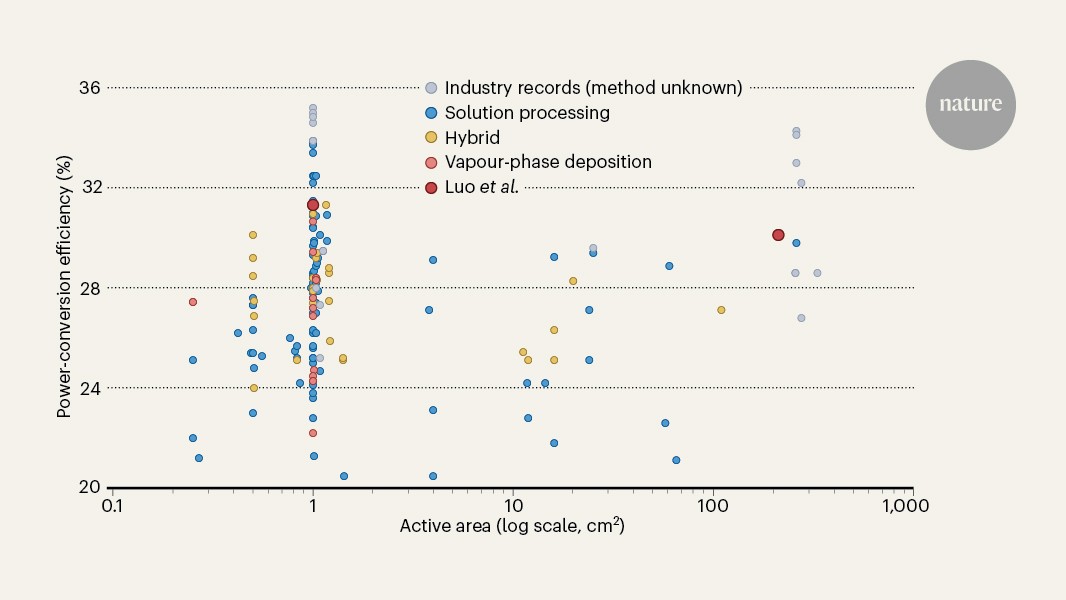
Market-leading solar cells use crystalline silicon to convert sunlight into electricity, but have essentially reached the limit of the percentage of incoming light that they can harness. Solar cells that use materials called perovskites in tandem with silicon can exceed the conversion efficiency of silicon-only devices and are rapidly approaching commercialization. Yet it remains uncertain which manufacturing process will enable economically viable production of such solar cells on an industrial scale1. Writing in Nature, Luo et al.2 report a key advance that suppresses the degradation of a compound that is used to make thin films of perovskites through a method called thermal evaporation. This enables the fabrication of high-performance perovskite–silicon tandem solar cells at much lower temperatures than have been needed previously, and at the sizes required for commercial production.
Access Nature and 54 other Nature Portfolio journals
Get Nature+, our best-value online-access subscription
Prices may be subject to local taxes which are calculated during checkout
Luo, C. et al. Nature https://doi.org/10.1038/s41586-026-10970-1 (2026).
Yang, G. et al. Nature Photonics 19, 913–924 (2025).