// NATURE NEWS — SPAZIO & SCIENZA
Daily briefing: Celebrating Dolly Parton’s contributions to science
Search author on:
PubMed
Google Scholar
Hello Nature readers, would you like to get this Briefing in your inbox free every day? Sign up here.
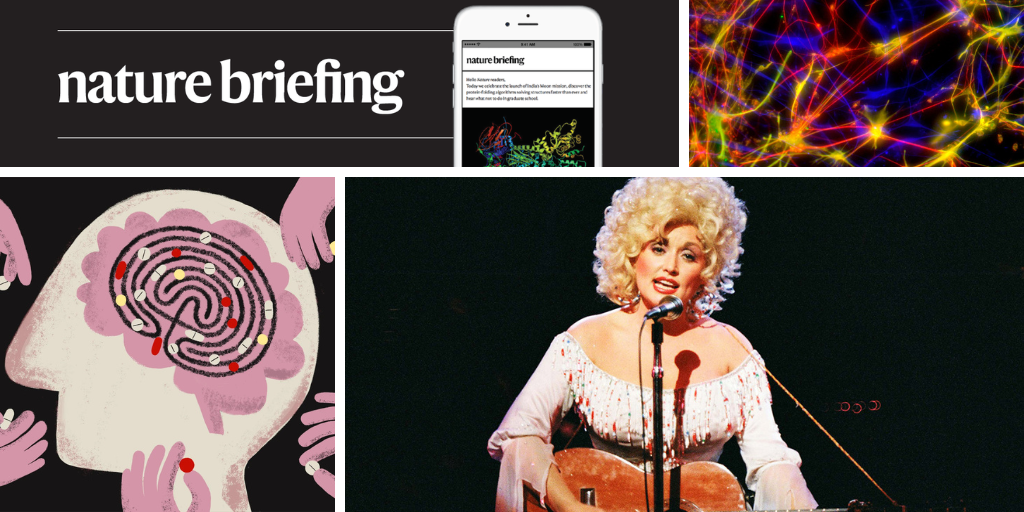
Dolly Parton on stage at The Dominion Theatre in London, United Kingdom, in 1983.Credit: Pete Still/Redferns via Getty
Dolly Parton has died at the age of 80, leaving a legacy of music, philanthropy and science. She helped to fund Moderna’s early-stage vaccine research and filmed herself being vaccinated to help dispel hesitancy. And her Imagination Library programme sends more than three million books per month to children around the world. “Today is a sad day as we mourn an exceptional artist, a true champion of kindness, and ambassador of science and public health,” says Tedros Ghebreyesus, director-general of the World Health Organization.
The number of images, found in the antibody catalogues of 15 companies, that seem to have been digitally altered, according to a scientific-integrity specialist. (Nature | 9 min read)
The next in China’s series of lunar probes, Chang’e-7, has been rescheduled at the last minute until 2027. The mission aims to arrive near the south pole — a rock- and crater-strewn region known for being challenging to land on — to hunt for water ice and study moonquakes. The China Manned Space Agency did not give a reason for the delay in its single-sentence announcement on Sunday.
The brains of people with depression seem to be worse at producing new neurons than are those of people without the disorder. That’s according to a study that includes the most comprehensive map of the cell types in the human adult hippocampus, a brain region involved in learning, memory and emotions. “This paper, excitingly, is the first to show at single-cell resolution exactly where in the process things appear to be awry and what molecular machinery is involved,” says neuroscientist Amelia Eisch.
Selective serotonin reuptake inhibitors, or SSRIs, are among the most prescribed medications in the world, and can be life-saving. Yet, even after decades of use, scientists are still struggling to understand exactly how they work. Another question — and the crux of recent criticism of SSRIs by US health secretary Robert F. Kennedy Jr — concerns what happens when people stop taking the drugs. That process can be difficult and involve withdrawal and relapse symptoms, even though scientists generally agree that SSRIs are not addictive.
AI-detecting tools such as Pangram and GPTZero claim that they can identify text generated by large language models, almost every time. And platforms that integrate the tools — such as alphaXiv, a mirror of the arXiv preprint server — are bringing them to a wide audience. But although software can spot whether AI was involved in a piece, it can’t prove how AI was used or judge what’s ethically acceptable. That, researchers say, could be an inescapable limitation of AI detection, however good it gets.
Poor sleep harms health, reduces productivity and puts workplace safety at risk — all of which could incentivize employers to start tracking our shut-eye, write bioethicists Brian Earp, Sebastian Porsdam Mann and Effy Vayena. And, as more products promise to actually improve sleep, “when does institutional support for better sleep turn into an expectation?” they ask. “Researchers, ethicists and policymakers must explore such concerns before the technology matures and is used more widely.”