// HACKER NEWS — CYBERSECURITY
Queen Caroline turned King Arthur into an 18C royal PR strategy
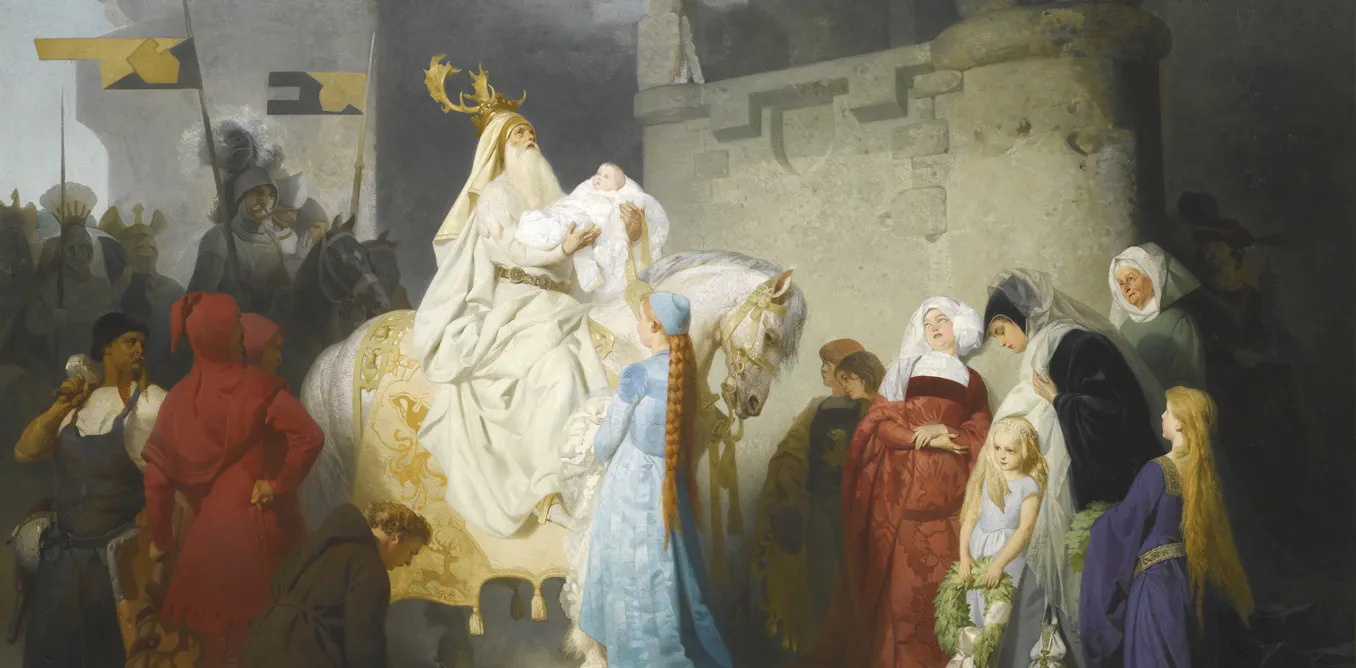
Amid family feuds, damaging headlines and questions about its future role, Britain’s royal family has spent much of the past decade managing its public image. But the importance of good royal PR dates back centuries.
Long before communications teams and media advisers became fixtures of royal life, Queen Caroline (1683-1737) attempted a remarkable piece of image management. Faced with the challenge of making a German royal dynasty seem unmistakably British, she turned to one of Britain’s most powerful national stories: the legends of King Arthur and Merlin.
As the wife of the king of Great Britain and Ireland, George II (1683-1760), Caroline belonged to the House of Hanover. The German dynasty had inherited the British throne only two decades earlier and was still viewed with suspicion by many of their subjects. At the same time, an increasingly public feud between the king and his heir, Frederick, Prince of Wales, threatened to undermine the image of stability that a country recently torn apart by civil war, religious schisms and political revolution so desperately needed.
Caroline’s solution to this problem was unexpected. In 1735, she commissioned a curious attraction in the gardens of her palace at Richmond. Known as Merlin’s Cave, it looked like something from a fairy tale: a gothic thatched building filled with wax figures of Merlin, legendary prophets and other figures from Britain’s distant past. Many contemporaries thought it bizarre, with one critic dismissing its inhabitants as “a great many strange puppets”.
Yet Merlin’s Cave was far more than an eccentric garden folly. Although an unlikely tool of statecraft, Caroline’s use of Arthurian iconography sought not only to strengthen the Hanovarian claim but also to promote a shared British identity at a time of political uncertainty.
Although the House of Hanover had inherited the British throne in 1714, it did not yet possess a deep-rooted place in the nation’s imagination. George I (who reigned 1714-1727) preferred his native Hanover to his new dominion and had relied heavily on interpreters and intermediaries throughout his reign. This exposed the dynasty to accusations that they were foreign rulers.
Supporters of the exiled Stuart dynasty, known as Jacobites, continued to regard James II’s son, the “Old Pretender” James Francis Edward Stuart, as Britain’s legitimate king. They had attempted ill-fated but bloody uprisings in 1715 and 1719. On his accession to the throne in 1727, George II therefore faced a challenge that was both political and cultural: he needed to not only rule Britain, but to persuade his people that he belonged there.
Arthurian legend offered a solution to this problem. Unlike the Jacobite claim, which emphasised hereditary right, it provided access to something broader and potentially more powerful: the idea of a shared British past. Arthur and Merlin were useful precisely because they belonged to no single dynasty. They could be appropriated to cultivate a different kind of legitimacy – one founded on patriotism, national identity and Britain’s historical traditions.
Queen Caroline was well placed to appreciate Arthur’s political usefulness. Unlike her husband, who famously cared little for the arts, Caroline was an enthusiastic reader who understood the political value of culture. Raised in the intellectually vibrant courts of Berlin and Hanover, she had access to extensive libraries that exposed her not only to Arthurian myth but to traditions linking the House of Guelph – the Hanoverian dynasty – with medieval English royalty.
While earlier monarchs such as Henry II and Edward I had often appropriated Arthur directly as a model of kingship, Caroline shifted attention towards Merlin. Throughout Arthurian tradition, Merlin acts as an adviser, genealogist and interpreter of Britain’s future. He guides Arthur while also foretelling the destiny of the realm. By placing Merlin at the centre of her cave, Caroline was employing these asso