// SPACE.COM — SPAZIO & SCIENZA
Meeting Nancy Grace Roman: What was the 'mother of Hubble' really like?
When you purchase through links on our site, we may earn an affiliate commission. Here’s how it works.
Nearly a decade ago, I found myself laughing alongside one of the most iconic women in astronomy. This week, a telescope bearing her name launches to the stars. So let's travel back in time and meet Nancy Grace Roman together.
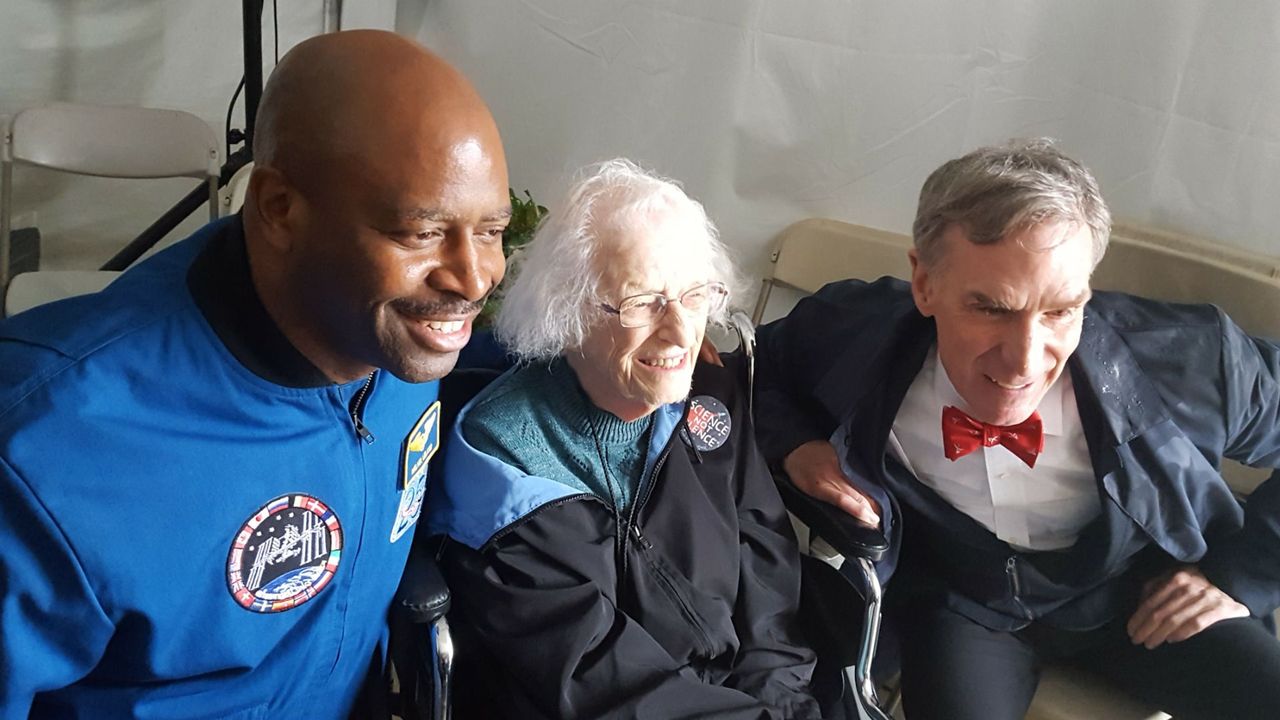
Standing under a tent in Washington D.C. at the 2017 inaugural "March for Science," a hodgepodge of scientists and reporters crowd together as the rain pours down outside. "That's Nancy Roman," I hear Bill Nye whisper to me as we stood on the outskirts of the tent. And as I struggled to keep my cool next to one of my childhood heroes, here he is pointing out another.
Looking across the room, I see her. There, in the corner of the tent, a woman with white hair wearing a "science not silence" pin sits by herself, soaking in the scenery. I hadn't noticed her before as, with the noise and crowd, it was tough to notice much of anything. But Bill was right. There she was, the "mother of Hubble." The woman who pioneered astronomy at NASA and pushed space science into the future.
If you're not too familiar with Nancy, let's speed run a little bit of information about the woman whose name was chosen to represent NASA's latest space telescope.
Nancy Grace Roman, born in 1925, was a pioneering astronomer and the first chief of astronomy at NASA. In creating and leading NASA's astronomy program, she was also the first woman in an executive position at the agency.
She earned the nickname "mother of Hubble," because of the critical role that she played in realizing the Hubble Space Telescope. She spent all 93 of her years exploring the universe.
Now, in this moment I'm already overwhelmed meeting Bill Nye for the first time. Unsurprisingly, I was a science-obsessed 90s kid who would wait my turn at the computer just to explore the lab in the Bill Nye CD-ROM game. But now, all of a sudden I'm also made aware that this woman who paved the way for modern astronomy is just sitting right there, mere feet away from me across the tent. And I knew I had to say hello.
"Hi, it's so nice to meet you," I offer, reaching out my hand to shake hers, unsure of what else to say. "I'm a bit starstruck."
And without missing a beat, she responds: "You know, I have a thing for stars," delivering the quip with a small laugh and a bright sparkle in her eye.