// HACKER NEWS — CYBERSECURITY
Creepy Crawlies
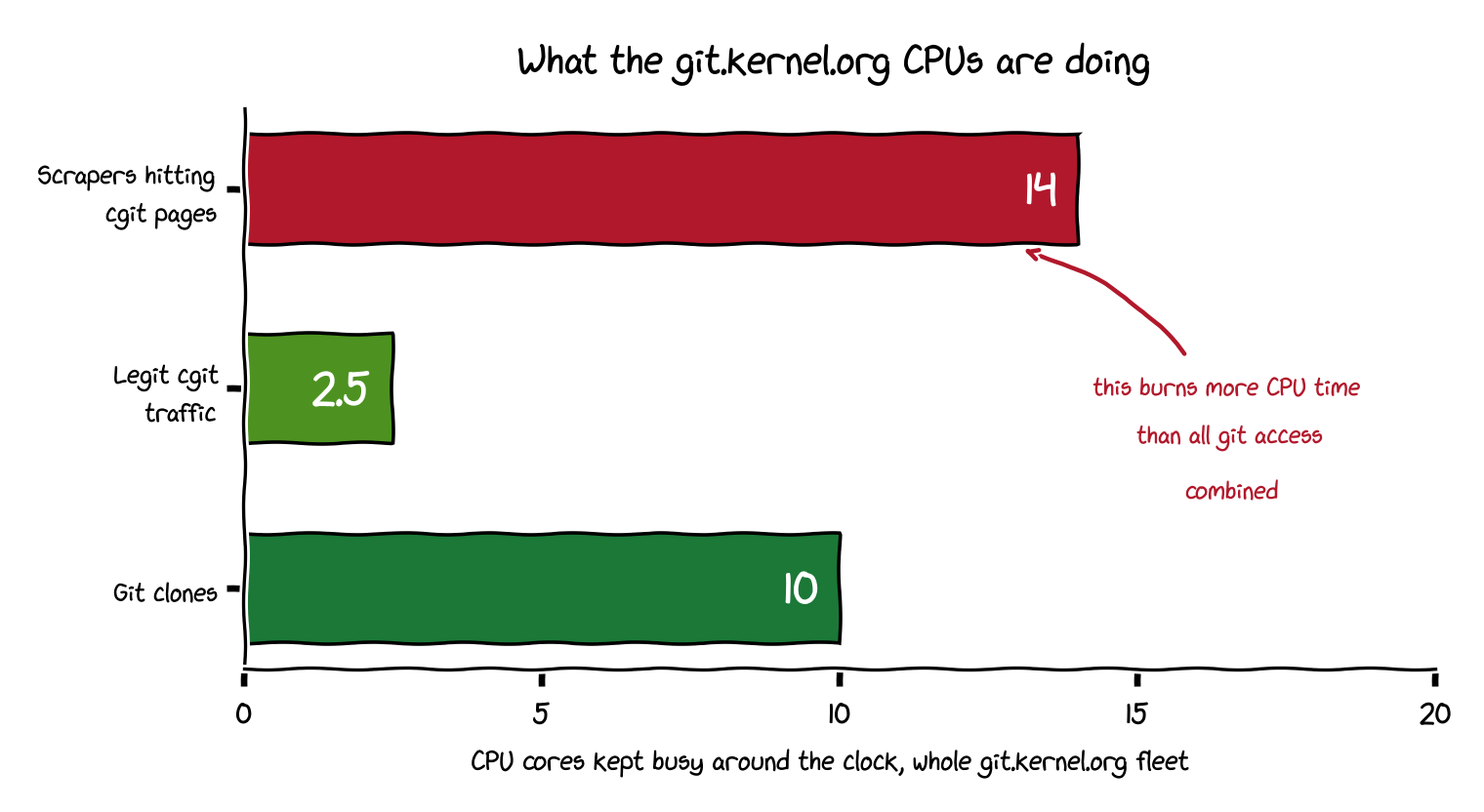
You've probably heard me complain about the “AI crawlers” before, but now I actually have some hard numbers I can put up to show their impact. In a few words, it's bad enough to create a constant “background radiation” of system load, permanently tying up a chunk of capacity spent on producing output that is only useful for a single purpose — feeding a learning model.
TL;DR: we spend more CPU cycles rendering commits for scrapers than we spend on all other kinds of legitimate access, including git clones. At any one time, across 5 geo-distributed nodes, there are 14 CPU cores doing nothing but rendering git commits as html.
Linux development happens in the open — from git repositories you can clone, to discussion archives you can follow in real time. To a large language model, this is a goldmine of learning data, because all of this is not only immediately available, but is easy to filter in order to guarantee pure unadulterated pre-AI content. Training an LLM on content produced by the LLM gives it the equivalent of a digital prion disease, so when a source is guaranteed to be LLM-free, like the entire history of kernel commits, it's worth its weight in gold as a source of training data.
We make almost everything clonable, because hey — we may not be around forever, so here — clone the repos. Also, clone the archives. Grab a copy just so we're not the only ones who have it all. Seriously, it's just a “git clone” away — and then you'll have the whole history.
For example, did you know you can clone the entirety of LKML and then do whatever you want with it? It's just git repos all the way down.
So, you'd think that something that pretends to be “Artificial Intelligence” would use the most efficient way of using our data for training purposes, right? Clone the repos, walk every commit. Done.
But no, let's in fact choose the stupidest possible way of doing it — by rendering everything as HTML commit by commit and then parsing it.
At the time of writing, linux.git is about 1.48 million commits. Oh, and we have about 922 forks of it on git.kernel.org — but don't worry, it's actually extremely efficient on the backend, since it's mostly the same objects in every fork.
Unless, of course, you're a scraper, in which case you have, oh, several BILLION valid URLs you can scrape, only to get 922 duplicates of the same 1.48 million commits — which is exactly what the scrapers are doing.
But wait, it's not just commits itself. You can also ask for patches, plain renders, diffs between arbitrary commits — cgit is happy to let you, which was perfect for the times when the Internet was for humans or crawlers who obeyed robots.txt, and is AWFUL right about now, because we can generate 1.2 METRIC BAJILLION valid URLs just for a single fork of linux.git.