// PC GAMER — GAMING
Pimax Dream Air review
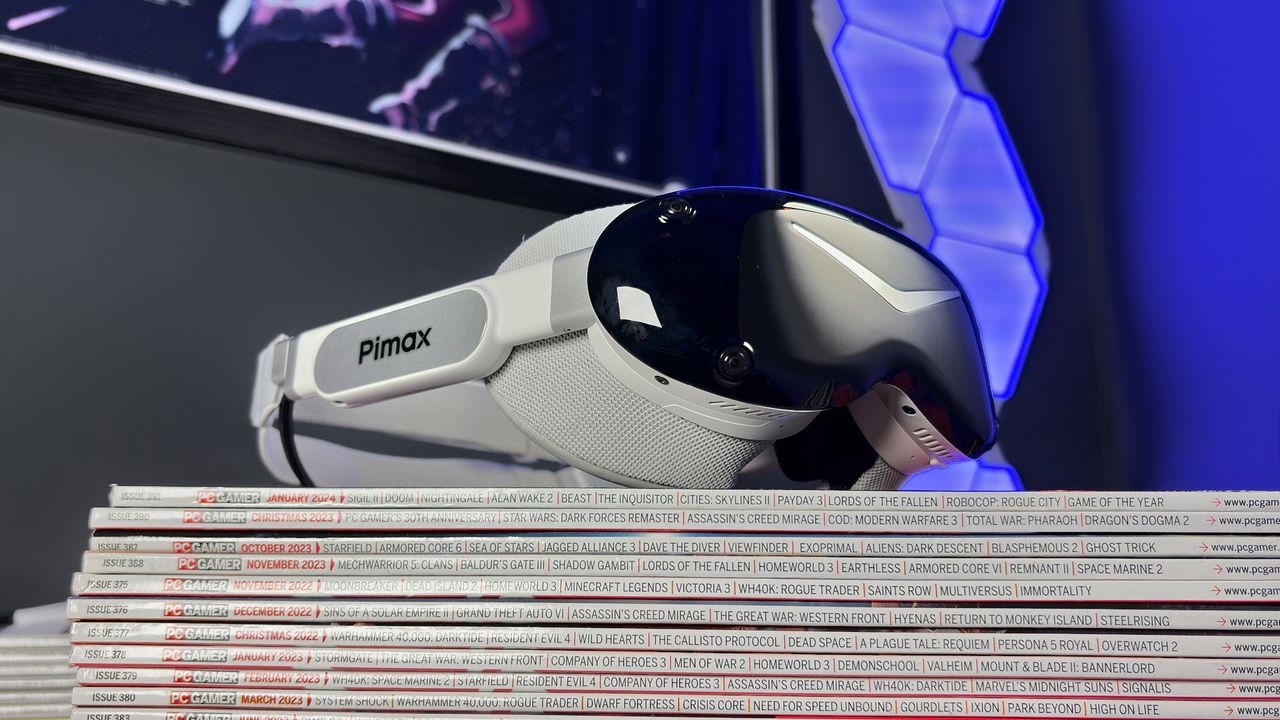
Pimax's slickest VR headset yet. The best I've tested for visual fidelity and long-term comfort; if only its tracking was as competent as the competition's.
PC Gamer's got your back
Our experienced team dedicates many hours to every review, to really get to the heart of what matters most to you. Find out more about how we evaluate games and hardware.
I've made my feelings about Micro-OLED displays pretty clear: these tiny screens are the future of high-end virtual reality. They're stunning; with deep blacks, a stunning range of colours, and none of the usual pitfalls of non-OLED displays. The Pimax Dream Air has two of them, hidden away beneath a compact pancake lens system. It's the only VR headset I've worn as of late that made me say "wow" out loud—I haven't done that since, well, probably the first time I wore a VR headset.
The Dream Air is tiny, too. It more closely resembles a pair of ski goggles than the company's other VR headset, the Crystal Super, which looks more like a prop from an '80s sci-fi movie than a modern-day wearable. Both are impressive in their own way—my first time experiencing Micro-OLED was in the Crystal Super—but the Dream Air's diminutive size and light build make it far more comfortable to wear over long periods.
So, it's the best VR headset, right? I wish it were that clear cut. I've not tried anything that gets close to the Dream Air in terms of visuals, size, and comfort; however, it lacks finesse in tracking. The model I've been testing uses Pimax's own inside-out tracking technology called SLAM, and whether it's this or the run-of-the-mill controllers that Pimax bundles with all its headsets, it's not up to the job as well as others. I wish that weren't such a dampener on the whole thing, but it really is the Achilles' heel of the Dream Air as it stands today.
Not every VR game requires controllers. Flight sims, racing sims, and anything with immersive, non-standard controls are best suited to the Dream Air. Though these games often come with their own set of challenges to deal with. While the Dream Air doesn't have the widest field of view (FOV) for these sorts of experiences, it has something even better, in my opinion. So, let's get into the details.
✅ You hate the feeling of a hefty headset on your head: The Dream Air is a very comfortable VR headset, owing mostly to its diminutive size.
✅ You enjoy sim gaming: For its superb visuals and sleek design, the Dream Air has no rival for sim racing among VR headsets I've tested.
❌ You want to play a fast-paced shooter or VR sports: The tracking on the controllers just isn't up to scratch, especially when compared to other cheaper headsets on the market.
❌ You don't have a high-end graphics card: This is a seriously demanding headset, with a resolution to make a graphics card squirm.