// NATURE NEWS — SPAZIO & SCIENZA
Robust inference and correlates from genetic associations with personality
Nature
(2026) Cite this article
Personality traits describe stable differences in how people think, feel and behave, and how they interact with and experience their social and physical environments1,2. Many questions remain unanswered about associations between DNA and personality traits, such as their robustness, their generalizability and the biological and social pathways through which they act. Here we meta-analyse data across 46 cohorts comprising 611,037 to 1.14 million participants with European-like and African-like genomes for genome-wide association studies (GWAS) of the Big Five personality traits (extraversion, agreeableness, conscientiousness, neuroticism and openness to experience), and data from up to 50,725 participants for within-family GWAS. We identify 1,260 lead genetic variants associated with personality, including 824 novel variants3. Common genetic variants explain a moderate 4.8–9.3% of the variance in measures of each trait, and 9.3–13.3% among instruments with typical measurement reliability. Genetic associations with personality are highly consistent but not identical across geography, reporter (self versus close other), age group and measurement instrument, and we find minimal spousal assortment for personality in recent history. In contrast to many other social and behavioural traits4,5, within-family GWAS and polygenic index analyses indicate that genetic associations with personality are minimally confounded by the shared family environment. Polygenic prediction, genetic correlation and Mendelian randomization analyses indicate that personality traits have widespread, potentially causal associations with consequential behaviours and life outcomes. Overall, we find that the genetic architecture of personality is robustly generalizable, minimally confounded and widely relevant to human experience.
Personality is defined by relatively stable patterns of thinking, feeling and behaving that vary across individuals1,2. Decades of research have demonstrated that human personality traits can be meaningfully and efficiently summarized by five relatively independent broad factors known as the Big Five: extraversion (which encompasses traits such as sociability, assertiveness and energy level), agreeableness (compassion, respectfulness and trust), conscientiousness (organization, productiveness and responsibility), neuroticism (anxiety, depression and volatility) and openness to experience (imagination, curiosity and aesthetic sensitivity)6,7. Given personality’s relevance to labour market outcomes8,9,10, physical health10,11,12, mental health13,14 and human demography15,16,17, understanding the molecular genetics of personality is important for developing biopsychosocial models of human behaviour and life outcomes.
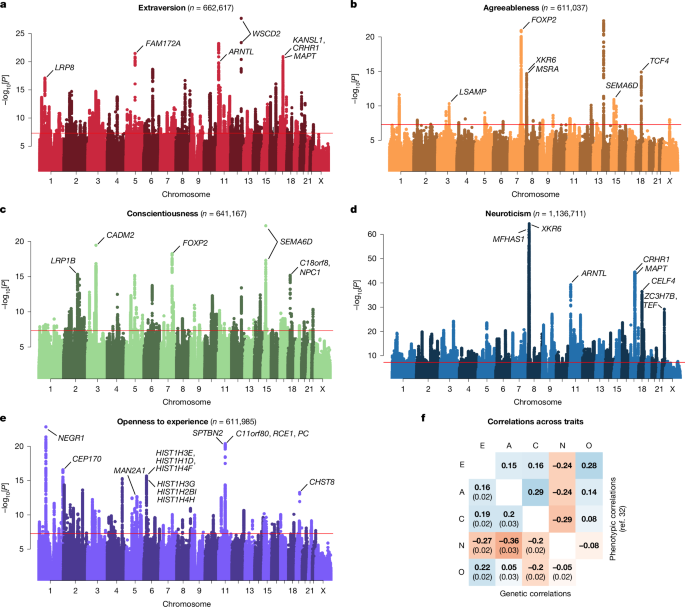
Here we report meta-analytic GWAS results from the Revived Genomics of Personality Consortium (ReGPC), a collaboration across 46 cohorts incorporating between 611,037 and 1.14 million participants per Big Five trait. We also provide a frequently asked questions document that explains the rationale and results of this study in everyday language (https://osf.io/crh9d). This effort increases the number of significant loci relative to most recent work18 from 3 to 131 for conscientiousness, from 4 to 39 for agreeableness, from 8 to 126 for openness to experience, from 14 to 258 for extraversion and from 224 to 706 for neuroticism. The additive effects tagged by the common genetic variants (single-nucleotide polymorphism (SNP) heritability, h2SNP) account for an estimated 4.8–16.2% of total personality variation across traits and models. This is consistent with previous GWAS of personality3,19,20,21,22 and less than estimates of h2 from classic twin and pedigree studies and molecular genetic methods that index effects of rare variants and genetic interactions, which range from around 40% to 60%18,23,24,25. Critically, all methods find that personality is substantially