// NATURE NEWS — SPAZIO & SCIENZA
Exploring baryon semileptonic decays through polarization and entanglement
Nature
volume 657, pages 92–97 (2026) Cite this article
The unitarity of the Cabibbo–Kobayashi–Maskawa (CKM) matrix is a cornerstone of the standard model (SM). Precise tests of this unitarity require independent determinations of its elements, such as |Vus|, which governs the transition between strange and up quarks. Current measurements from kaon and tau decays show tensions that may hint at physics beyond the SM1,2,3. Hyperon semileptonic decays provide alternative probes but have remained largely untapped because previous experiments lacked sufficient kinematic information, making the measurements insensitive to the relevant form factors4. Here we report measurements of the axial-vector and weak-magnetism couplings, as well as the first determinations of the absolute branching fraction and weak-electricity coupling in \(\Lambda \to {{\rm{pe}}}^{-}{\bar{\nu }}_{{\rm{e}}}\), achieved by exploiting the polarization and quantum entanglement of \(\Lambda \bar{\Lambda }\) pairs produced at the J/ψ resonance. Combining our results with recent lattice quantum chromodynamics (QCD) calculations5 gives |Vus|LQCD = 0.2339 ± 0.0041, a model-independent determination consistent with CKM unitarity. By pioneering the exploitation of polarization and quantum entanglement in baryon semileptonic decays, our method enhances single-event sensitivity and is broadly applicable to other baryon semileptonic decays, establishing the foundation for a systematic research programme that can achieve precision comparable with that of kaon decays and provide a stringent independent test of the SM.
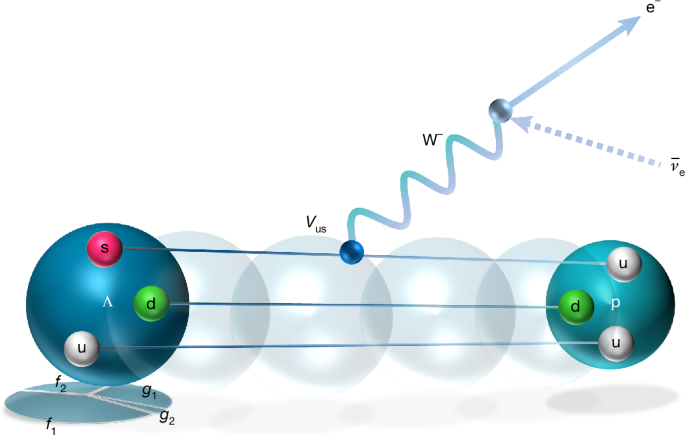
Transition form factors are fundamental hadron properties describing the dynamic behaviour of the transition between two states. The transition matrix element for a semileptonic weak decay of a hyperon is parametrized by six form factors, fi(q2) and gi(q2) (i = 1, 2, 3). These represent the vector and axial vector parts of the weak interaction, respectively, and depend on the squared momentum transfer, q2, of the intermediate W boson. The vector form factors are commonly denoted as the vector f1(q2), weak magnetism f2(q2) and scalar f3(q2) form factors. The axial-vector form factors are further subdivided into the axial g1(q2), weak electricity g2(q2) and pseudoscalar g3(q2) form factors6. Each form factor is associated with a specific current and encodes information about the underlying hadronic structure. Because both the scalar and the pseudoscalar form factors are suppressed by the squared ratio of the lepton to hyperon mass, the electron–antineutrino decay modes effectively depend only on four form factors and Vus, as depicted in Fig. 1.
The pie chart shows the relevant magnitudes of the dominant vector and axial-vector form factors partaking in the transition.
When neglecting the q2 dependence of the form factors, the branching ratio \({\mathcal{B}}\) of the semileptonic decay \(\Lambda \to {{\rm{pe}}}^{-}{\bar{\nu }}_{{\rm{e}}}\) is given by6:
in which β = (MΛ − Mp)/MΛ ≈ 0.159, with MΛ and Mp denoting the masses of the Λ and proton, respectively. The weak decay constant GF and the Λ lifetime τΛ are known with high accuracy4. The form-factor-dependent function \({{\mathcal{F}}}_{2}\) is defined as:
The ratios g1/f1 (throughout this paper, fi ≡ fi(q2 = 0) and gi ≡ gi(q2 = 0) are implied, unless explicitly noted), f2/f1 and g2/f1 represent the axial-vector (gav ≡ g1/f1), weak-magnetism (gw ≡ f2/f1) and weak-electricity (gav2 ≡ g2/f1) couplings at zero momentum transfer q2, respectively. Therefore, a precise measurement of the decay branching fraction can be used to determine |Vus| if the form factors are known. The relative couplings gav, gw and gav2 can be determined from kinematic angular variables, but a reliable theoretical determination of f1 requires an understanding of the subtle differences between the d and s quarks7. In this context, approximate flavour SU(3) symmetry serves as a good approximation, as confirmed b