// NATURE NEWS — SPAZIO & SCIENZA
Rewiring the ribosome to translate proteins encoded in its own RNA
Nature
(2026) Cite this article
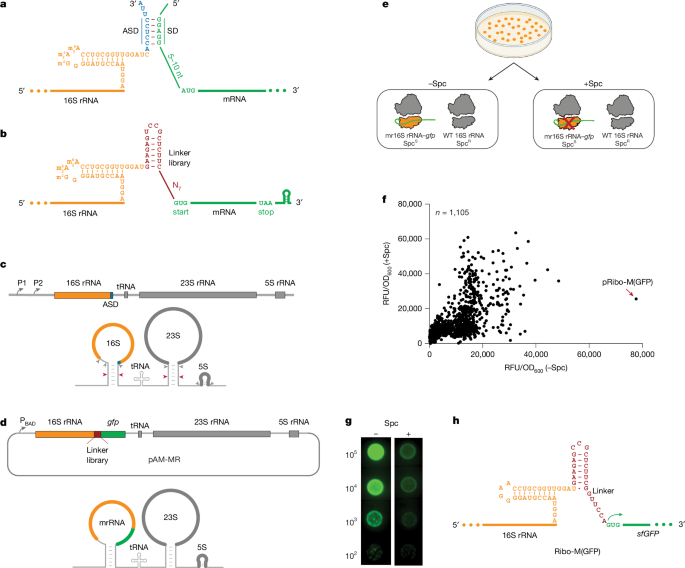
Cellular protein synthesis relies on random encounters between ribosomes and mRNAs, limiting optimization of the translation machinery for production of a single protein—a key need in biotechnology. One potential solution is integrating the protein-coding sequence into the ribosome itself, thereby committing the ribosome to synthesis of a single polypeptide. The feasibility of such integration could also address a long-standing challenge in RNA world models: explaining how early protein synthesis could function reliably despite the scarcity and poor organization of its components1. Whether a ribosome can translate its own ribosomal RNA (rRNA) has remained unclear. Here we show that bacterial ribosomes can synthesize proteins encoded within their own RNA. We engineered a chimeric messenger–ribosomal RNA (mrRNA) by appending a protein-coding sequence to 16S rRNA. The hybrid mrRNA assembles into a small ribosomal subunit that binds to the large subunit to form Ribo-M, a ribosome capable of translating mrRNA-encoded proteins. Translation is abolished by mutations or antibiotics that impair the function of the small subunit, demonstrating that mrRNA translation is carried out in cis by ribosomes assembled on the chimeric mrRNA. Incorporating mrRNA into a ribosome with tethered subunits yielded Ribo-TM, in which encoding, decoding and peptide synthesis are united within a single RNA scaffold. These findings establish the mechanistic feasibility of a ribosome translating its own rRNA in vivo and in vitro, offering a versatile platform for orthogonal protein production and insights into the origin of translation.
This is a preview of subscription content, access via your institution
Access Nature and 54 other Nature Portfolio journals
Get Nature+, our best-value online-access subscription
Prices may be subject to local taxes which are calculated during checkout
The key plasmids and strains are available from Addgene or the corresponding author on request. The raw data and key nucleotide sequences of the constructs are provided in the Supplementary Information. Complete sequences of the key plasmids used in this work are provided in the Supplementary Information.
Wolf, Y. I. & Koonin, E. V. On the origin of the translation system and the genetic code in the RNA world by means of natural selection, exaptation, and subfunctionalization. Biol. Direct 2, 14 (2007).
Article
PubMed
PubMed Central
Google Scholar
Shine, J. & Dalgarno, L. The 3′-terminal sequence of Escherichia coli 16S ribosomal RNA: complementarity to nonsense triplets and ribosome binding sites. Proc. Natl Acad. Sci. USA 71, 1342–1346 (1974).