// NATURE NEWS — SPAZIO & SCIENZA
NASA’s Roman telescope holds promise far beyond mapping the invisible Universe
Priyamvada Natarajan is professor of astronomy & physics at Yale University in New Haven, Connecticut, USA, where she is also co-director at the Yale Center for the Invisible Universe.
Search author on:
PubMed
Google Scholar
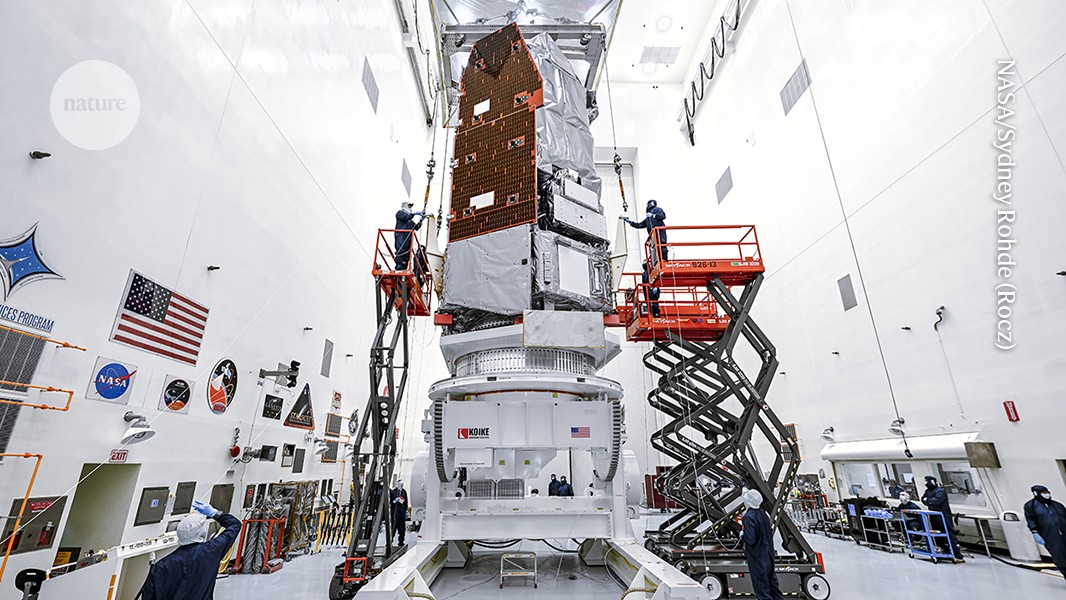
The Nancy Grace Roman Space Telescope is set to test current descriptions of dark matter, dark energy and gravity itself.Credit: NASA/Sydney Rohde (Rocz)
On 30 August, a remarkable instrument left Earth. Sealed into a SpaceX rocket, it will travel some 1.5 million kilometres and begin looking out into the cosmos.
The Nancy Grace Roman Space Telescope stems from scientific bricolage. Its 2.4-metre primary mirror was built for terrestrial surveillance, transferred to NASA in 2012 and extensively re-engineered into an observatory to peer at what remains unseen — dark matter, dark energy, distant planets and the hidden architecture of the Universe.
Lift-off! NASA launches Roman Space Telescope to tackle dark-energy mysteries
Much more than an irresistible origin story, this resourceful improvisation is an emblem of how science advances. Researchers like to tell the story of discovery as a clean sequence: pose a question, build an instrument to answer it, collect the evidence and arrive at an explanation. But science is rarely so linear. Instruments outlive the purposes for which they were conceived. Ideas developed for one problem migrate into another. Fresh theoretical questions make old observations newly valuable. Technologies mature along independent paths and address questions their inventors could never even have anticipated.
The Roman space telescope embodies this type of intersection. Its mirror is a similar diameter to the Hubble Space Telescope’s, but its Wide Field Instrument, a huge 300-megapixel infrared camera, can capture a patch of sky roughly 100 times larger in a single exposure. Hubble transformed astronomy by looking deeply; Roman will add another mode of seeing, combining exquisite resolution with panoramic reach. It will survey rather than stare. And that difference changes the kinds of question that can be asked.
Everything humans can see — stars, planets, galaxies and ourselves — represents only a small fraction of the cosmic inventory. Most of the matter in the Universe seems to be dark matter, detectable only through its gravitational effects. More mysterious still is dark energy: whatever is causing cosmic expansion to accelerate. My own work has long been concerned with this peculiar problem of mapping what cannot be seen directly: reconstructing the invisible scaffolding of matter from the distortions it leaves on light. The Roman telescope will attempt this on an unprecedented scale and stands to fundamentally reshape if not upend scientists’ current understanding.
Countdown to Artemis: is NASA’s Moon mission the dawn of a new space age?