// HACKER NEWS — CYBERSECURITY
The race to engineer new knobs for the human brain
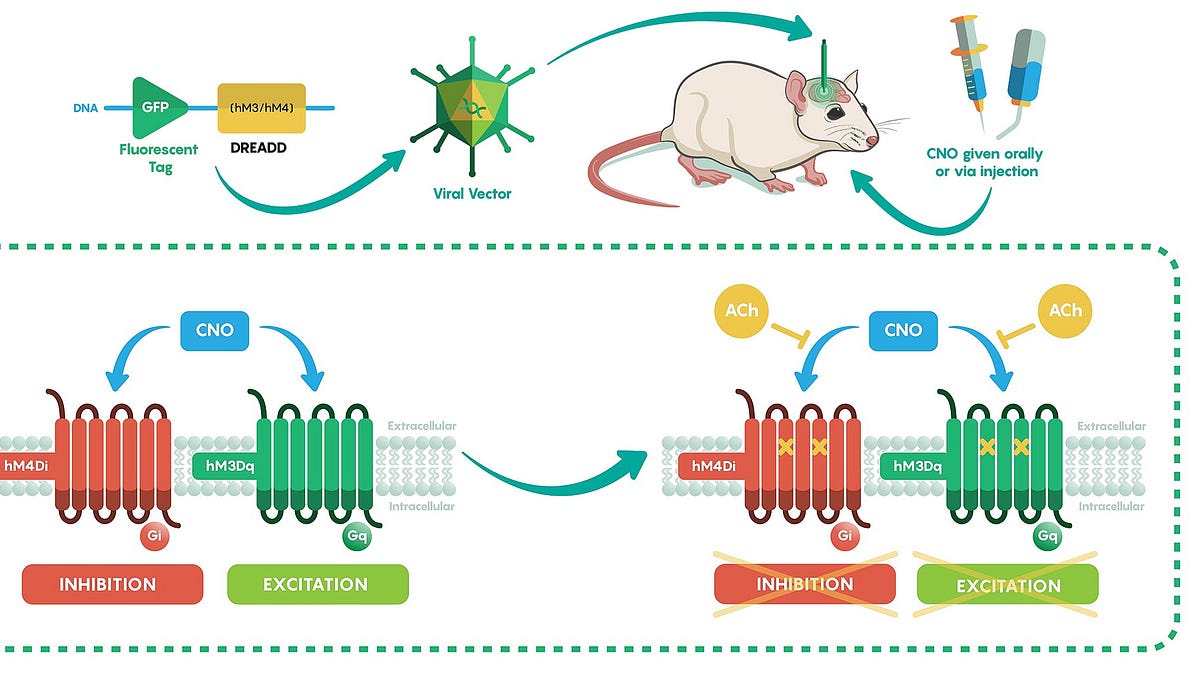
I almost dropped my phone when I saw the news that chemogenetics was in human clinical trials. Chemogenetics is a powerful technique that modifies specific neurons so they can be controlled remotely by normally inert drugs. Bryan Roth, one of the technique’s inventors, told the BRAIN Initiative conference audience on August 13th1 that he had found seven ongoing clinical trials of chemogenetics in China. The disclosure set off a flurry of coverage in the trade media: We’re translating our sci-fi basic neuroscience tools to humans! We’re engineering new knobs for biology! We might have new ways of treating epilepsy, Parkinson’s disease, and pain!
Chemogenetics and DREADDs (designer receptors exclusively activated by designer drugs) are very cool. Many of you will be familiar with optogenetics, which engineers neurons to respond to light by inserting a gene adapted from a light-sensitive microbe. Chemogenetics is similar in spirit but lets neurons respond to designer chemicals. Once a gene for a synthetic receptor is expressed in a neuron, the neuron can be driven—excited or inhibited—by its designer chemical, creating a genetically-targeted therapy that can be controlled and titrated remotely by taking more or less of the designer chemical.
We’ve come a long way towards treating neurological and neurodegenerative disorders since I was in grad school. Back then, we had three tools for affecting the human brain at the source: small molecules (e.g. fluoxetine), electromagnetism (e.g. DBS, tDCS, TMS, ECT), and changing the sensory environment (e.g. psychotherapy). Now we have developed many more: peptides (e.g. GLP-1R agonists like Ozempic), antibodies (e.g. anti-CGRP meds for migraines), focused ultrasound (either high intensity for ablations or low intensity for modulation). Most relevant to this discussion, we have a slew of methods that engineer neurons for therapeutic effect: optogenetics (thus far limited to the retina), chemogenetics, gene-editing therapies, and cell therapies.
These latter are different in kind, because they actually change neurons—or add new ones—often irreversibly, in humans. I had been following the DREADD story peripherally, and I learned a lot by digging into papers that discuss the technology and the descriptions of the clinical trials. In this post, I will unpack DREADDs and chemogenetics, describe what those first clinical trials are doing, and how we might improve upon them. In a follow-up post, I will discuss a competing technology, cell therapy, for the central nervous system.
Bryan Roth shared this slide at the BRAIN Initiative meeting. Searching through different Chinese clinical trial databases, he found 7 clinical trials for three indications: pain, Parkinson’s disease, and epilepsy. Not all are operating currently; some are pre-recruitment; it adds up to roughly 10 patients. Nevertheless, China is building momentum to advance human chemogenetics.
How can chemogenetics be useful? Consider epilepsy, an indication targeted by three of the ongoing trials. Epileptic seizures happen when a person gets focal runaway excitation. Uncontrolled epilepsy (i.e. refractory) can severely disrupt a person’s life, exposing them to personal injury during seizures, making it impossible to drive or even stay employed. At worst, refractory epilepsy can be fatal, leading to sudden unexpected death.
One way to stop seizures is to decrease overall activity in the epilepsy focus. However, most treatments do this in a much coarser way: they decrease overall activity everywhere in the brain. For example, benzodiazepines (e.g., diazepam, or Valium), which potentiate all GABA receptors in the brain, are used as a first-line treatment to control acute seizures. They cause habituation, dependence, and severe drowsiness. They are untargeted. Wouldn’t it be nice if we had a way to stop runaway excitation by decreasing activity only at the focal point of the epilepsy?
DREADDs allow neurons to be modulated by normally i