// NATURE NEWS — SPAZIO & SCIENZA
Functional chimeric mRNAs encode proteins in mammalian immunity
Nature
(2026) Cite this article
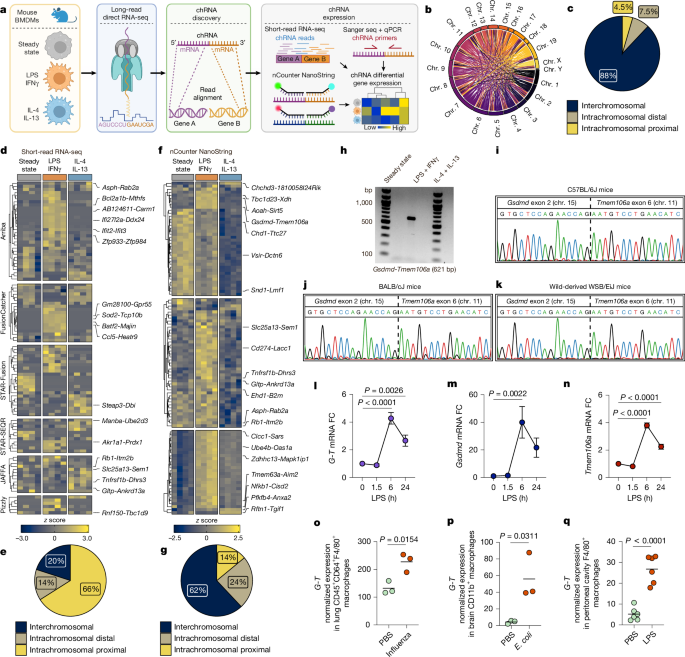
Individual mammalian mRNAs and proteins are typically believed to originate from single genomic loci, with isoform diversity arising through cis-splicing of pre-mRNA. Whether mRNA from distant genes can undergo trans-splicing to generate functionally relevant chimeric transcripts has remained unclear. Here we develop a pipeline combining long-read direct RNA sequencing with non-targeted and targeted validation to identify chimeric transcripts in macrophages. Chromatin conformation capture studies reveal that inflammation induces interchromosomal DNA interactions, positioning parent genes proximally to facilitate the formation of chimeric mRNA. Notably, we identify a protein-coding chimeric mRNA representing a fusion between the pore-forming protein gasdermin D (GSDMD)1,2 and a C-terminal domain translated out of frame from Tmem106a (Gsdmd-Tmem106a) in mice. We show that inflammasome priming upregulates Gsdmd-Tmem106a, with the protein localizing to the plasma membrane. After activation of the inflammasome, GSDMD–TMEM106A directly interacts with canonical GSDMD N termini to accelerate and enhance pore formation and IL-1β release. Finally, we show that GSDMD–TMEM106A balances host defence and immunopathology in vivo: its loss protects against lethal sepsis but compromises antibacterial defence, whereas overexpression enhances host protection while increasing sepsis lethality. We establish that protein-coding chimeric mRNAs formed by regulated transcript fusion events are operative during inflammation and immunity.
The diversity of proteins produced by cells is typically defined by the repertoire of individual genes encoded in the genome. This diversity can be amplified through pre-mRNA cis-splicing, where varied pairings of exons within a given transcript can be differentially fused. It is unclear whether mechanisms beyond cis-splicing exist to diversify the protein-coding capacity of mammalian cells. In unicellular and invertebrate organisms, the process of trans-splicing, whereby exons from distinct pre-mRNAs are fused to create hybrid proteins, has been reported. In trypanosomes and nematodes, a common pre-mRNA is trans-spliced to various other mRNAs to promote transcript stability and translation3; by contrast, in Drosophila, this process generates functionally diverse transcripts and proteins4. In healthy mammals, few examples of trans-splicing exist, and functional chimeric mRNAs (chRNAs) are typically associated with oncogenic transformation of cells where genomic translocations fuse disparate genes at the DNA level5,6. Expression of some chRNAs known to be produced by DNA translocation have also been described in non-malignant tissue and are proposed to form through trans-splicing7,8,9. However, it remains to be elucidated whether, in healthy mammalian cells, widespread fusion of mRNA from distinct genes can produce chRNAs that encode functional proteins. However, one can predict that such fusion events would expand the number of physiological protein-encoding mRNAs far beyond what is currently appreciated in our genomes.
Despite advances and widespread adoption of RNA sequencing (RNA-seq) methodologies, endogenously expressed chRNAs in mammals have largely evaded discovery because of technical limitations. cDNA synthesis-based approaches are used extensively and rely on viral reverse transcriptase enzymes to convert RNA to cDNA. However, viral reverse transcriptase enzymes can generate artificial fusion transcripts through template switching10. Furthermore, as mammalian chRNAs are not annotated in reference transcriptomes, candidate chRNAs multimap to different parts of the genome during alignment, resulting in their routine removal during standard RNA-seq analyses. Short-read sequencing also limits chRNA detection, as read fragments are assigned as chimeric only if they span the junction at which one gene meets the other; otherwise, these reads are assigne