// NATURE NEWS — SPAZIO & SCIENZA
Daily briefing: A thrilling hint of dark-matter discovery
Search author on:
PubMed
Google Scholar
Hello Nature readers, would you like to get this Briefing in your inbox free every day? Sign up here.
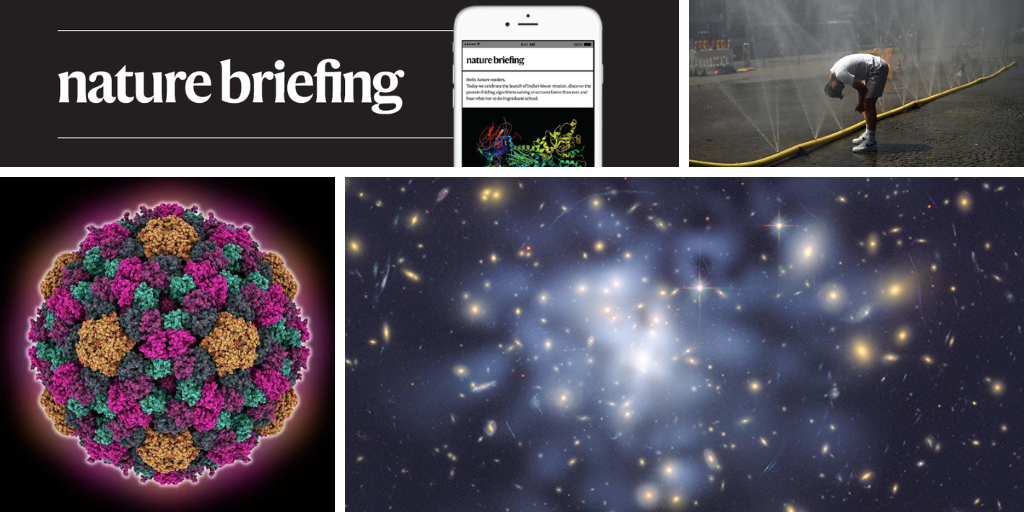
An image captured with the Hubble Space Telescope shows the distribution of dark matter in the center of the giant galaxy cluster.Credit: NASA/JPL-Caltech/ESA/IAA, University of Basque Country/JHU
A single data point from a dark-matter detector in the United States could be the first discovery of the elusive particle we call dark matter. The LUX-ZEPLIN experiment at the Sanford Underground Research Facility in South Dakota contains 10 tonnes of liquid xenon. It seeks evidence of a candidate particle called a WIMP (weakly interacting massive particle) by looking for flashes created when such a particle collides with the nucleus of just one xenon atom. If the finding can be backed up with more data, it could mean that the material that seems to make up most of the mass of the Universe has finally been discovered.
Reference: Lawrence Berkeley National Laboratory preprint (not peer reviewed)
The United Nations Environment Programme has released a report acknowledging that the world will fail to meet the Paris climate agreement goal of limiting global warming to 1.5 ℃ above the preindustrial average, with warming of at least 1.8 ℃ expected this century. “All of our pathways forward are overshoot pathways,” said climate scientist and co-author Debra Roberts. However, the report suggests that, with a huge expansion of CO2 removal efforts, it might still be possible to return to below 1.5 ℃ by the end of the century. And every fraction of a degree counts. “The lower the peak warming reached, the lower the risks,” says the report.
Researchers have created more than 44,000 variants of the well-studied bacteriophage virus ΦX174 to determine the effects of mutations at nearly every single one of its DNA letters and amino acids. Most mutations were detrimental to the virus’s survival, but a handful boosted its fitness, often for reasons that were unclear. Cutting-edge AI models trained to identify harmful mutations struggled to predict the consequences of each change, which underscores the need for more high-quality experimental data to power these models, the team says.
In June, the Indian government launched the Prime Minister Research Chair (PMRC) Scheme, an initiative to entice Indian researchers who have moved abroad to return. The programme offers 120 researchers up to 50 million rupees (roughly US$520,000) in research grants, with extra stipends and allowances, for five years to work at an institution in India. The scheme could benefit theoretical physicists, but the grants aren’t sufficient to cover expensive equipment and infrastructure required for experimental research, say scientists. Nor does it lay out a path once the initial fellowship ends.
The widespread use of generative artificial intelligence across all facets of society appears to be stripping writing and imagery of individuality, say researchers who are studying the phenomenon. Evidence already suggests that this increased uniformity can influence how we make decisions and the opinions we hold, which could begin to homogenize human culture and cognition, they warn. This AI sameness might not upend society, but in a worst-case scenario, it could make people collectively less adaptable, says computer scientist Zhivar Sourati.
Fraudsters are messing with our honey, replacing some or even all of the sweet treat with low-cost sugar syrups: a 2023 European Commission report found that 46% of 300 lab-tested samples showed signs of being adulterated. But chemically analysing real honey is tricky because it’s sticky, acidic and wonderfully, naturally complex. “It’s got hundreds, if not thousands, of different trace compounds in there,” says honey expert David Hoyland. To make matters worse, not everyone agrees with what should legally be called ‘honey’.