// HACKER NEWS — CYBERSECURITY
A PCB business card with a batteryless LED, powered by the phone that taps it
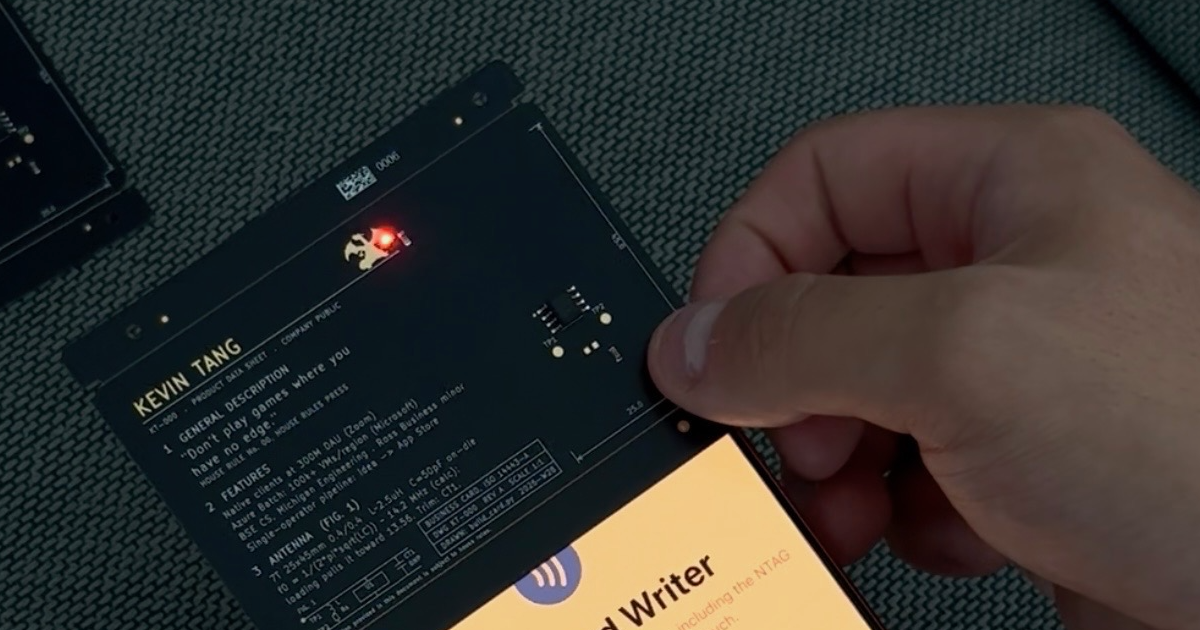
TL;DR: I made a circuit-board business card with an NFC chip and a batteryless LED powered by the phone tapping it. The hardware worked, but ordinary iPhone NFC apps couldn’t format the blank NTAG I²C Plus chip. I wrote a tiny Core NFC app that sends the chip’s native commands directly, and now each tap opens my site and lights Charizard’s tail.
I wanted a business card that wasn’t a piece of paper. Not out of some deep philosophy—I just thought it would be fun to hand someone a circuit board. So I designed one: credit-card sized, glossy black, with gold artwork and my name on it. Standard so far. The two things that make it not-just-a-card are both invisible until you bring a phone near it.
The first is an NFC chip. Tap the card to a phone and it opens kevintang.xyz—the same technology as a tap-to-pay card or a transit pass, running at 13.56 MHz[1]. There’s a spiral of copper wound seven times around the edge of the board; that’s the antenna, and getting it to resonate at the right frequency is most of the work. That part I expected.
The second thing is the part I can’t stop thinking about. There’s a little Charizard printed on the card, and a red LED sits right at the tip of its tail—so tap the card to a phone and its tail catches fire. There’s no battery on the card. There’s no coin cell, no wire, nothing to charge. The LED is running entirely on energy the phone is throwing off.
The card mid-write—my own little app pushing the URL onto the chip—with the harvest LED lit from nothing but the phone’s field. Several more waiting their turn.
Here’s what’s actually happening, and it took me a while to stop finding it magical (I haven’t, really). An NFC phone doesn’t just listen for a tag—it broadcasts a strong radio field to power the tag, because the tag has no battery either. The chip in a normal NFC sticker wakes up on that borrowed energy just long enough to answer, then goes dark the moment the phone leaves. What I didn’t appreciate until I built one is that some chips will hand you the leftover power on a pin, to do whatever you want with. NXP’s datasheet lists a typical harvested output of about 5 milliamps at 2 volts under one test setup[2]—not much, but plenty to light an LED, or blink a low-power sensor, or wake a tiny microcontroller for a fraction of a second.
And the way it answers is stranger than it sounds: the tag never transmits a signal of its own. It replies by changing how much of the phone’s field it absorbs, instant to instant, and the phone feels those little tugs on its own signal and reads them as ones and zeros. The analogy I keep coming back to is a mirror. A mirror makes no light—it only reflects a source. A passive NFC tag makes no radio of its own—it reflects the phone’s, flickering it into a message. The phone brings all the energy; the card just decides what to bounce back.
(This, incidentally, is the NFC-versus-RFID distinction I used to fumble: NFC isn’t a rival to RFID, it’s the short-range, 13.56 MHz corner of it—close range on purpose, so the card talks only to the thing you deliberately touch it to.)
I’d always thought of NFC as a way to make the phone do something: open a link, pay for coffee, check in. But this flips it. The tap makes the card do something. For the half-second your phone is near it, the card is a live device—an inert rectangle of fiberglass that comes alive in your hand because you brought a battery near it. Once you’ve felt that, you start seeing NFC taps differently. You’re not reading the tag. You’re powering it.
It’s not a brand-new idea—U.S. Bank shipped a credit card a few years ago whose logo glows during a contactless payment, and it was popular enough that they ran short of them[3]—but it’s rare, and it feels like a small miracle every time. And it points at a whole category of objects: things that don’t need a battery because they only need to be alive for the instant you’re touching them with a phone you were already holding.