// SPACE.COM — SPAZIO & SCIENZA
Scientists watch a comet being born 3 billion miles away
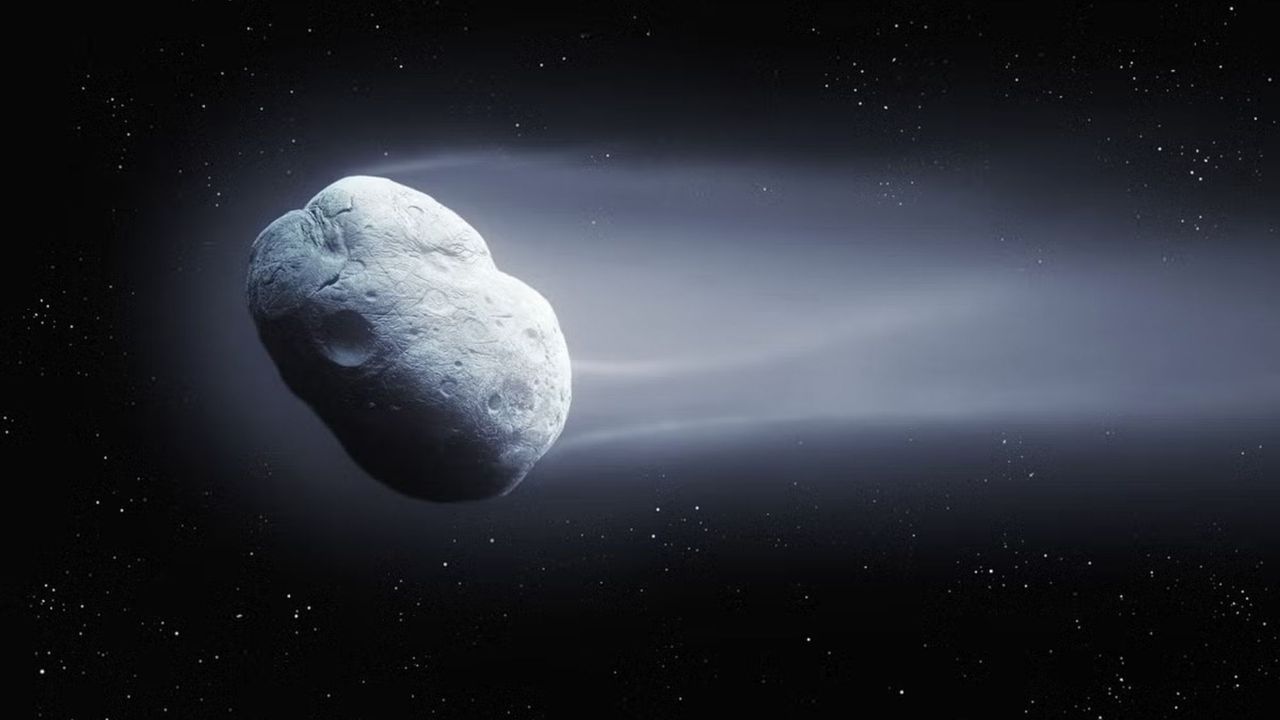
A rare look at a centaur transforming into a comet with coma is providing a missing link in the evolution of small, icy solar system bodies.
When you purchase through links on our site, we may earn an affiliate commission. Here’s how it works.
Astronomers have witnessed a small, icy body that orbits the sun out beyond Jupiter transforming into a comet, providing a missing link between comets and inert bodies called centaurs.
The object in question is called 450P/LONEOS and is named after the Lowell Observatory survey that found it back in 2004. It is a centaur, which is a breed of inactive body that orbits the sun between Jupiter and Neptune. These objects are thought to have wandered in from the Kuiper Belt beyond Pluto, their paths perhaps perturbed by distant gravitational interactions with the gas giant planets, or even a nudge from a passing star.
Because a given centaur's orbit crosses the path of at least one of Jupiter, Saturn, Uranus and Neptune, a centaur's orbit is unstable over millions of years. Consequently, the giant planets can push them even closer to the sun or kick them out of the solar system entirely.
It has long been suspected that those pushed closer to the sun turn into what are called Jupiter-family comets, which are comets with orbital periods around the sun of less than 20 years and which are influenced by the gravity of Jupiter.
To date, no one has ever seen a centaur turn into a Jupiter-family comet. The orbital period of 450P is currently 22 years, so it isn't a Jupiter-family comet yet, but astronomers led by planetary scientist Charles Schambeau of the University of Central Florida have been observing the onset of comet-like behavior on the centaur. In particular, using the Gemini North telescope in Hawaii they have seen the formation of a cloud of gas and dust called a coma around the solid nucleus of 450P, with this coma brightening in the period between 2019 and 2024, when 450P arrived at perihelion (the closest point to the sun in its orbit).
Should 450P keep up this comet-like behavior and receive one more gravitational nudge from one of the giant planets, then it could finally become a Jupiter-family comet.
"Studying objects like 450P helps us connect different stages of small-body evolution," said Schambeau in a statement. "Centaurs are likely related to trans-Neptunian objects, and some will eventually become short-period comets. By studying their activity, surface properties and volatile [substances with low boiling or sublimation points such as water and carbon dioxide] composition, we can learn how comet nuclei change as they move inward through the solar system, how long they preserve primitive ices and what physical processes turn an otherwise quiet icy body into an active comet."
Using the James Webb Space Telescope (JWST), Schambeau's team analyzed 450P's coma, finding carbon dioxide gas and suggestions of particles of crystalline ice and dust.