// NATURE NEWS — SPAZIO & SCIENZA
Tropical cyclones could be predicted with an extra day’s warning, thanks to an AI model
Tom Beucler is in the Faculty of Geosciences and Environment and the Expertise Center for Climate Extremes at the University of Lausanne, Lausanne CH-1015, Switzerland.
Search author on:
PubMed
Google Scholar
Milton Gomez is in the Faculty of Geosciences and Environment and the Expertise Center for Climate Extremes at the University of Lausanne, Lausanne CH-1015, Switzerland.
Search author on:
PubMed
Google Scholar
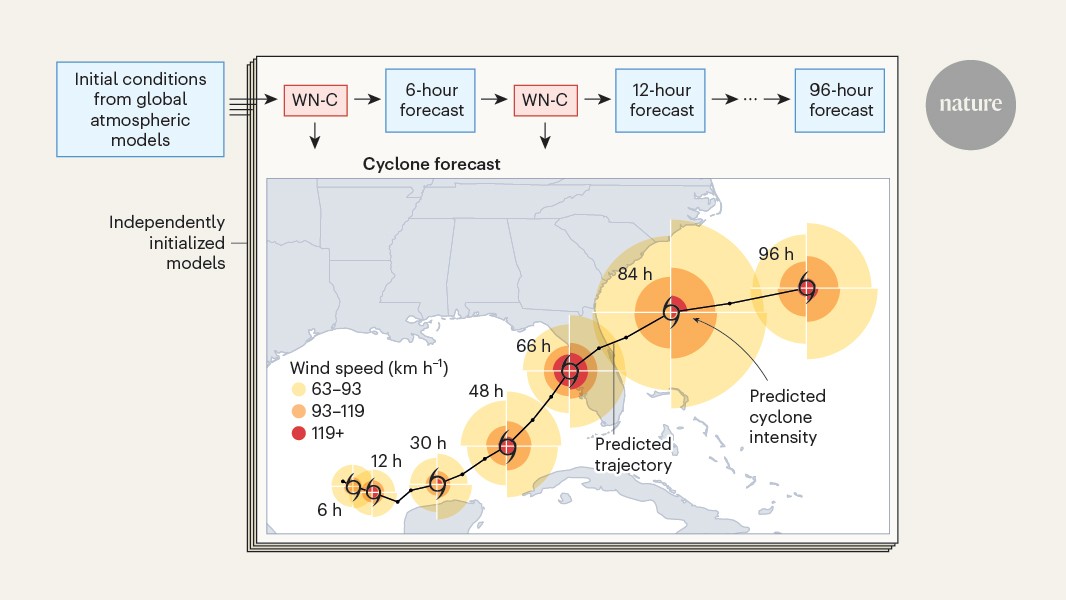
Tropical cyclones — also called typhoons or hurricanes, depending on where they occur — are a major cause of deaths worldwide, and inflict considerable damage on property and infrastructure. The formation and evolution of these rapidly rotating weather systems are driven by effects on a range of scales, which makes it incredibly challenging to forecast them accurately using conventional models. Now, writing in Nature, Alet et al.1 introduce WeatherNext Cyclones (WN-C), an artificial-intelligence model that can produce two-week forecasts of unfolding tropical cyclones.
Access Nature and 54 other Nature Portfolio journals
Get Nature+, our best-value online-access subscription
Prices may be subject to local taxes which are calculated during checkout
Alet, F. et al. Nature https://doi.org/10.1038/s41586-026-10953-2 (2026).
Mooney, K. R. et al. Earth Space Sci. 13, e2025EA004869 (2026).